
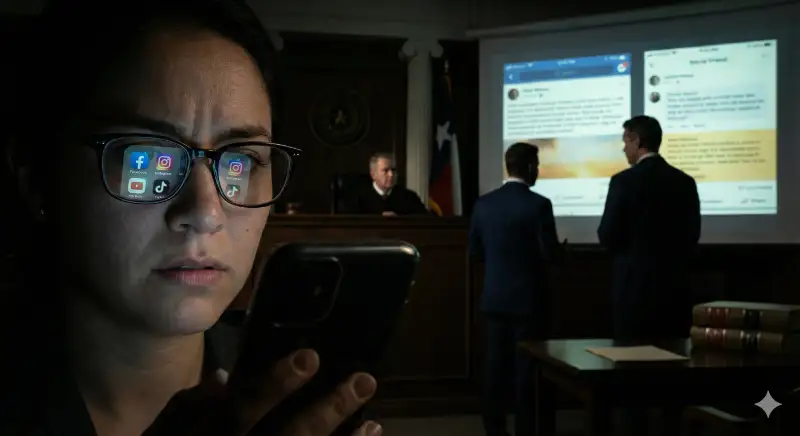
Social media posts can quietly undermine your personal injury case when you're just trying to connect with friends and family. More than 70% of American adults use social media platforms daily, leaving a digital footprint that insurance companies watch closely. We have handled numerous cases where one seemingly harmless post damaged an otherwise solid injury claim.
Insurance adjusters and defense lawyers systematically examine claimants' social media accounts, searching for content that might contradict injury claims. Picture this: a client suffering from severe back injuries posts a photo smiling at her daughter's birthday party. The defense team immediately presents this image as "proof" that her pain isn't genuine. Simple comments, likes, or responses to friends' posts can be twisted and used against you during settlement talks or in court.
At The Martinez Law Firm, we've watched digital evidence become a major factor in personal injury cases across Austin and surrounding areas. Texas operates under a modified comparative fault system—if you're deemed partially responsible for an accident, your compensation gets reduced. If you're found more than 50 percent at fault, you recover nothing. This rule makes protecting your online presence absolutely critical while your case is active.
Key factors that make social media dangerous for injury victims:
Insurance companies monitor your accounts systematically, not casually
Innocent posts get misinterpreted as evidence against your claim
Texas comparative fault rules can eliminate your compensation entirely
Digital evidence carries significant weight in court proceedings
We understand the challenges of staying offline when social media connects you to family and friends during difficult times. However, one careless post can cost you thousands of dollars in compensation you rightfully deserve.
Insurance companies don't casually scroll through your Facebook feed—they conduct organized investigations. With nearly 69% of American adults using Facebook and 40% using Instagram, your social media accounts become treasure troves for insurers determined to reduce their payouts.
Insurance adjusters hunt for contradictions between your claimed injuries and your digital life. They scrutinize posts for inconsistencies, match your online activities against medical records, and search for evidence that challenges your personal injury claim. When you file a claim, you're declaring that you've experienced physical, emotional, and financial damage—insurers aggressively pursue any content that seems to contradict these statements.
A 2023 Insurance Research Council survey revealed that over 80% of insurers now incorporate social media monitoring into their claims investigations. Their surveillance typically starts immediately—often within hours of your accident—and persists until your case closes.
The insurance company's investigation process includes:
Analyzing your posting patterns before and after the accident
Comparing your claimed limitations with online activities
Cross-referencing your statements with digital evidence
Building a timeline that challenges your injury narrative
Insurers utilize multiple strategies to gather your social media content:
Scanning publicly accessible information
Examining mutual connections and tagged photos
Requesting access through legal discovery processes
Even with maximum privacy settings, your digital presence remains exposed. Insurance companies often don't require special access—they compile public posts, tagged photos, comments, and geolocation data. Texas courts can order you to provide private content if it relates to your physical condition, emotional state, or accident statements.
Common collection methods include:
Public Profile Scanning: Reviewing all publicly visible content
Network Analysis: Checking friends' and family members' posts that mention you
Legal Discovery: Formally requesting access to private accounts through court orders
Digital Forensics: Recovering deleted content through specialized techniques
Texas courts routinely accept social media posts as valid evidence when they're relevant to a case. Under Texas Rules of Evidence 401 and 402, evidence becomes admissible if it makes any fact more or less probable.
Texas courts authenticate social media evidence using the "reasonable juror" standard from Tienda v. State. This standard requires sufficient evidence for a reasonable juror to conclude the content is genuine. Authentication happens through witness testimony, metadata analysis, or circumstantial evidence.
Critical warning: Deleting posts after filing your claim constitutes destruction of evidence (spoliation), which can severely damage your credibility and case outcome. Deleted content often remains recoverable through digital preservation methods.
We've seen clients lose significant compensation because they underestimated how thoroughly insurance companies investigate social media accounts. Your digital footprint creates a permanent record that can be used against you long after you've forgotten about a particular post or interaction.
We've witnessed numerous injury cases destroyed by posts that seemed completely innocent at the time. These real situations show exactly how online activity can devastate legitimate claims.
Physical activity photos create the most damaging evidence against injury claims. A Fort Worth motorcyclist claimed severe back pain and limited mobility, then posted Facebook photos of himself hiking with the caption "Back at it!" The jury awarded significantly less compensation. What these images don't capture is the full story—that ten-second video doesn't show you spent the next three days bedridden from pain.
Insurance adjusters systematically compare your online activities with medical records, hunting for any inconsistencies. Consider this case: a plaintiff sought $1.2 million for chronic pain following a botched surgery. She posted on Facebook about attending a concert, describing it as a "great night out." Defense attorneys presented these posts in court, resulting in a settlement reduction to $400,000—an $800,000 loss.
The posts that destroyed her case:
Facebook check-in at the concert venue
Photos smiling with friends at the event
Comments about having "an amazing time"
No mention of pain or discomfort
Harmless statements can obliterate your claim's value. Posts like "feeling better today!" suggest rapid recovery, while apologizing for an accident can be interpreted as admitting fault. Even responding to a friend's comment with "All good now!" might be twisted as evidence of complete recovery. A 2024 study found that 40% of malpractice cases involving social media evidence resulted in lower settlements due to perceived inconsistencies.
Texas courts consistently uphold social media evidence as admissible. A Dallas woman claimed she couldn't return to work due to debilitating anxiety, yet checked in on Facebook at a comedy club, posting selfies laughing with friends. Her settlement offer dropped by nearly 40%.
Similarly, a Houston teenager who suffered a concussion posted a TikTok dance video. Defense attorneys used this to argue she wasn't experiencing dizziness or cognitive delays. The video lasted 15 seconds, but the defense presented it as proof she had fully recovered.
Under Texas Rules of Evidence 401 and 402, any evidence making a fact more or less probable is admissible. This broad standard explains why social media continues to undermine personal injury claims across Texas.
We understand the physical, emotional, and financial toll that these evidence battles create for our clients. That's why we emphasize social media protection from the moment you hire us.
Understanding these frequent missteps can protect your claim from unnecessary damage. We see clients make these same errors repeatedly, often without realizing the potential consequences.
Accident details shared online become permanent evidence that defense attorneys will use against you. A simple status update like "feeling better today" gets presented in court as proof your injuries aren't severe.
The problem with injury-related posts:
Photos of any physical activity suggest you're exaggerating your condition
What you don't share remains invisible to insurance adjusters
Context gets stripped away when posts appear as evidence
That hiking photo doesn't show you spent three days in bed afterward. The smiling family picture doesn't capture the pain medication you needed to get through the event.
Insurance companies routinely create fake social media profiles to access your private content. These investigators monitor your activity systematically, searching for contradictions they can use against your compensation claim.
Red flags to watch for:
Friend requests immediately following your accident
Profiles with limited history or generic information
Requests from people with mutual friends but no clear connection to you
Unknown friend requests after your accident could be defense investigators attempting to infiltrate your accounts. Reject all unfamiliar connection requests until your case concludes.
Once litigation begins, never delete social media content. Texas courts consider this "spoliation of evidence" under Rule of Civil Procedure 215.2.
Removing posts suggests you knew they were damaging—which often harms your case more than the original content would have. Even deleted material can be recovered through preservation techniques, making deletion both risky and pointless.
Discussions about fault create devastating evidence against you. Comments in threads, direct messages, or community group discussions can all be discovered during litigation.
Statements that destroy cases:
"I should have been paying more attention"
"Maybe I could have avoided it"
"I was running late and rushing"
Even casual remarks suggesting distraction or shared fault become admissions of liability. Avoid the temptation to "name and shame" the other party online—such posts could be interpreted as threats or extortion.
Taking immediate steps to protect your online presence is essential after any accident. We understand the challenge of staying connected with loved ones while safeguarding your legal claim, but these precautions can save you thousands in lost compensation.
Complete silence on social media platforms provides the strongest protection during your case. Insurance adjusters can twist even the most innocent posts against your claim . If going completely offline feels impossible, restrict your activity to content that has no connection to your physical condition, daily activities, or emotional state .
What to avoid posting:
Photos showing any physical activity
Comments about feeling better or worse
Check-ins at locations outside your home
Reactions to friends' posts about you
Change all your accounts to private immediately, but remember this only provides limited protection. Courts can still order access to your private content if it relates to your physical condition or the accident . Privacy settings create a barrier against casual surveillance but won't stop determined investigators.
Defense teams routinely search your friends' and family members' profiles for any mention of your activities. Request that your close contacts avoid tagging you in photos or discussing your situation online . A well-intentioned post from your sister about "glad to see you getting out" can damage your case just as much as your own content .
Before sharing any content online, contact your attorney first. We can evaluate existing posts that might create problems and advise you on the safest approach moving forward . This collaboration protects your credibility and prevents costly mistakes.
Insurance companies use sophisticated surveillance methods to gather evidence against your claim. They create fake profiles to send friend requests, monitor public posts continuously, and examine tagged photos from mutual connections . Some companies even petition courts to force access to your private accounts .
Common investigation tactics include:
Fake friend requests from attractive profiles
Monitoring location data from check-ins
Searching for tagged photos you didn't post yourself
Analyzing comment histories and interactions
Remember, what seems like casual social media use to you represents potential evidence to insurance companies looking to minimize your settlement.
Social media poses serious threats to your personal injury case in Texas. We have seen how a single post can undermine months of building a strong claim for our clients across Austin and surrounding areas.
Insurance companies are not your friends—they conduct targeted surveillance with one goal: reducing what they pay you. Your photos, comments, check-ins, and even responses to friends' posts become weapons against your claim. What seems innocent today can cost you thousands of dollars tomorrow.
Privacy settings provide false security. Texas courts can order access to your private accounts when they contain relevant case information. The only reliable protection is stepping away from social media entirely while your case is active.
At The Martinez Law Firm, we guide clients through these digital minefields every day. We understand how defense teams twist innocent content and use it to question your credibility. Our team knows the tactics insurance companies employ to collect your online activities.
Critical steps to protect your claim:
Pause all social media activity during your case
Inform friends and family not to tag or mention you online
Never delete existing posts—this constitutes destruction of evidence
Consult your attorney before posting anything
Texas law allows social media evidence in court when it relates to your case. What you share online today could determine your compensation tomorrow. Your recovery should be your focus—let us handle protecting your legal rights both online and in the courtroom.
Don't let social media destroy what you deserve. Contact The Martinez Law Firm today at (512) 444-0025 for a free case evaluation. We protect accident victims throughout Austin, Buda, Kyle, Bastrop, San Marcos, Pflugerville, and Round Rock. Your fight for justice starts with one phone call.
Social media activity can silently destroy your Texas injury case, as insurance companies systematically monitor your online presence to find contradictory evidence. Here are the critical insights every injury victim needs to know:
• Insurance companies actively surveil your social media - Over 80% of insurers now use social media monitoring as part of their claims investigation process, often beginning within hours of your accident.
• Innocent posts can devastate legitimate claims - A single photo showing physical activity or a comment like "feeling better today" can be twisted to suggest you're exaggerating injuries, potentially reducing settlements by hundreds of thousands of dollars.
• Privacy settings don't guarantee protection - Texas courts can compel access to private accounts if content relates to your case, and investigators often use fake profiles to infiltrate your network.
• Never delete posts after filing a claim - Removing social media content is considered "spoliation of evidence" under Texas law and can harm your credibility more than the original posts.
• The safest strategy is complete social media silence - Pause all activity during litigation and ask friends not to tag you, as even their posts about you can become damaging evidence.
Remember: What you share online today could appear in court tomorrow. When your financial recovery is at stake, temporary digital silence is a small price to pay for protecting your case's integrity.
Q1. How can social media posts affect my personal injury case in Texas? Social media posts can significantly impact your case by providing evidence that contradicts your injury claims. Insurance companies and defense attorneys actively monitor claimants' social media profiles for any content that might undermine the severity of injuries or suggest faster recovery.
Q2. Is it safe to use privacy settings on my social media accounts during a lawsuit? While adjusting privacy settings can add a layer of protection, it's not foolproof. Texas courts can still order access to private accounts if the content is deemed relevant to your case. It's best to limit or pause social media activity altogether during litigation.
Q3. What should I do if I've already posted about my accident or injuries online? Consult your attorney immediately. Do not delete any posts, as this can be considered destruction of evidence. Your lawyer can assess which existing posts might present risks and guide you on how to handle them appropriately.
Q4. Can comments or posts from my friends and family affect my injury claim? Yes, posts or tags from friends and family can potentially harm your case. It's advisable to ask your close contacts not to mention you or your activities on their social media profiles during the duration of your case.
Q5. What are some common social media mistakes that can damage a personal injury case? Common mistakes include posting about the accident or injuries, accepting friend requests from unknown users (who may be insurance investigators), deleting posts after filing a claim, and engaging in online arguments about the crash. These actions can provide damaging evidence or negatively impact your credibility.




Schedule a free consultation with one of our experienced lawyers today by filling out the form below, or call us at 512-444-0025