
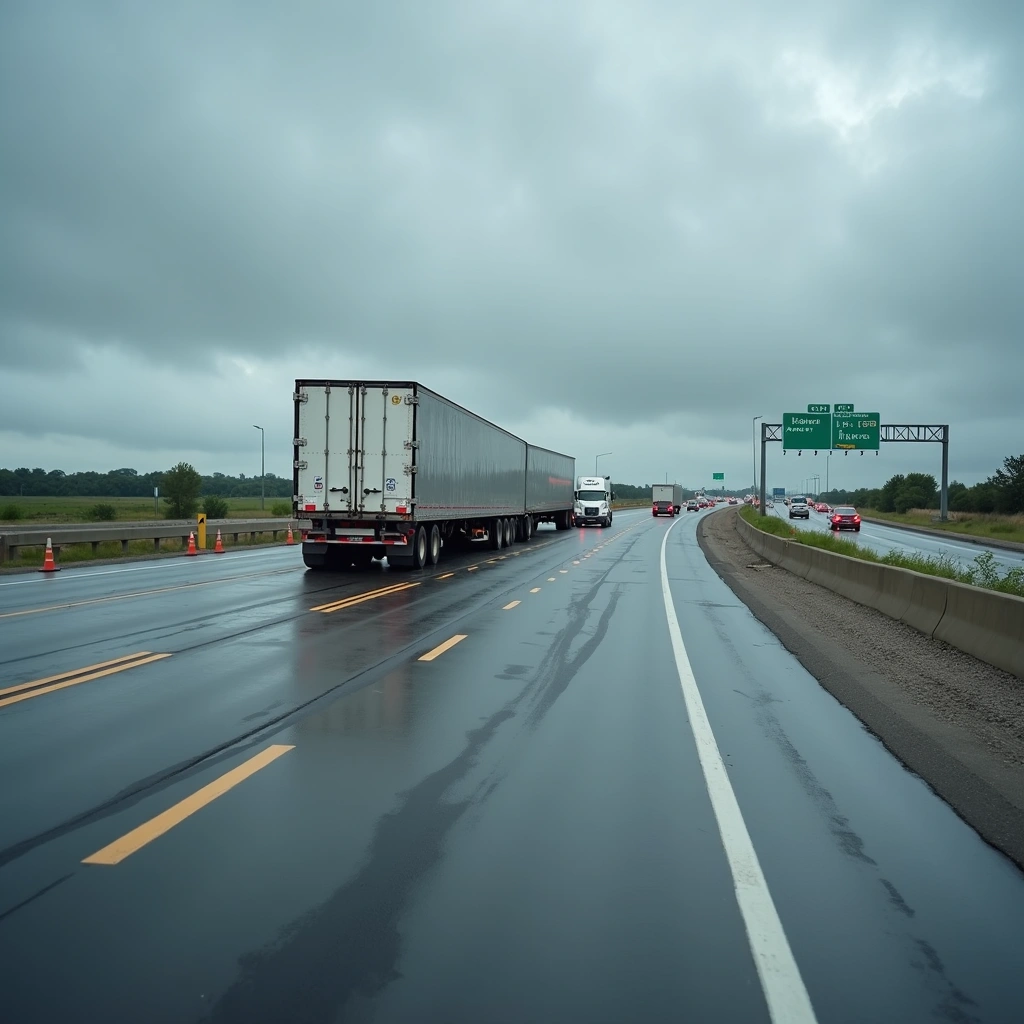
Tractor trailer jackknife accidents rank among the deadliest collisions on I-35. Data from 2023 shows that 4.4% of single-trailer semis and 7.1% of multi-trailer semis experienced jackknifing in fatal crashes. When a jackknifed semi swings across multiple lanes, other drivers have little to no time to react — and the consequences are often catastrophic. Knowing what causes a tractor-trailer to jackknife is essential for anyone who travels Central Texas highways regularly.
At The Martinez Law Firm, we've spent 28 years fighting for victims of these crashes. A trailer jackknife is likely to happen when brakes lock up, road conditions deteriorate, or mechanical failures go unaddressed. We're here to break down the real causes behind these accidents — and to explain how our team can pursue the full compensation you deserve after a life-changing collision.
Several factors contribute to tractor-trailer jackknife crashes on I-35, and understanding each one matters — both for road safety and for building a strong legal claim after an accident.
Sudden Braking This is the most common trigger. When a driver slams the brakes, the cab decelerates faster than the trailer, causing the trailer to swing sideways and fold into the jackknife position. Drivers who fail to maintain safe following distances or react too late to slowing traffic make this outcome far more likely.
Excessive Speed Speed dramatically increases the risk. A truck driver who exceeds the posted speed limit by just 10 miles per hour raises their chances of jackknifing by 49%. At highway speeds, the momentum of an 80,000-pound semi is difficult to control — particularly around curves or on downhill slopes where weight shifts uncontrollably.
Hazardous Weather Conditions Rain, ice, and snow are particularly dangerous on I-35. Rain alone increases jackknife risk by 3.22 times. Reduced tire traction makes it nearly impossible to maintain control during braking or steering, and drivers who fail to reduce their speed on wet roads put everyone around them at serious risk.
Improperly Loaded Cargo When cargo isn't loaded correctly — specifically, when 60 percent of the load isn't positioned toward the front of the trailer — the center of gravity shifts. Cargo that moves during transport makes the trailer unstable and prone to swinging during braking or turns.
Each of these causes points to a failure — whether by the driver, the trucking company, or another responsible party. That distinction becomes critical when determining who should be held accountable for your injuries.
Determining who caused your jackknife accident is rarely straightforward. Liability requires a thorough examination of every party involved in the truck's operation — and in most cases, more than one party shares responsibility for the crash.
The driver is often the starting point. Speeding, distracted driving, improper braking, and hours-of-service violations are all direct causes of a jackknifed semi. If the driver made choices that put your safety at risk, they can be held accountable.
Trucking companies face direct liability when they:
Fail to properly maintain their fleet
Hire unqualified or inadequately trained drivers
Pressure drivers to meet unrealistic deadlines
Under the legal doctrine of respondeat superior, employers are responsible for the negligent acts their drivers commit during work hours. This means both the driver and the company can be held accountable for the same crash.
When an unbalanced or unsecured load violates federal cargo securement standards under 49 CFR Part 393, the cargo loading company shares fault. Improperly distributed weight is a known trigger for trailer instability — and if a third party loaded that trailer negligently, they bear responsibility for what followed.
Third-party maintenance providers become liable when mechanical failures result from inadequate inspections or repairs they performed. Manufacturers face claims when defective brake systems or other component failures contributed directly to the jackknife.
Texas modified comparative fault rules allow you to recover damages as long as you are 50% or less responsible for the accident. Even if you share some degree of fault, you may still be entitled to significant compensation.
Proving these liability chains demands a thorough investigation — electronic logging device data, maintenance records, and driver logs all tell part of the story. We've recovered millions for Central Texas victims by identifying every responsible party and building cases that insurance companies simply cannot dismiss.
For over three decades, The Martinez Law Firm has helped Central Texas families rebuild their lives after devastating jackknife accidents. Our 98% success rate reflects the intensity we bring to every tractor trailer jackknife case. We've recovered millions for clients throughout Austin, Round Rock, Pflugerville, Cedar Park, Georgetown, Leander, Buda, Kyle, San Marcos, Bastrop, Elgin, West Lake Hills, Lakeway, and surrounding communities across Travis, Williamson, Hays, Bastrop, Caldwell, and Burnet counties.
Our founder, former municipal judge Arturo Martinez, brings a courtroom perspective that insurance companies take seriously. His "view from the bench" shapes both our negotiation strategies and our approach at trial — particularly when trucking companies refuse to offer fair settlements. Our fully bilingual staff serves the diverse Central Texas community in English and Spanish, so nothing gets lost in translation when it matters most.
Here's what you can expect when you work with us:
No upfront costs — we work on a contingency fee basis, meaning you pay nothing unless we win your claim
Immediate investigation — our team moves quickly to preserve black box data, maintenance records, and scene evidence before trucking companies have the opportunity to obscure the facts
Full accountability — we identify every liable party, from drivers to fleet owners to cargo loaders, and build cases that insurance companies cannot dismiss
Don't wait to get the help you need. Call us at (512) 444-0025 for a free case evaluation. Our office at 2101 S IH-35 Frontage Road, Suite 100, Austin, Texas 78741 is ready to fight for the compensation you deserve.
Jackknife accidents on I-35 can upend your life in a matter of seconds. The physical injuries, financial strain, and emotional toll that follow are real — and you shouldn't have to carry that burden alone.
At The Martinez Law Firm, we know how to build the case, identify every liable party, and fight for the compensation you and your family deserve. With a 98% success rate over 28 years, we've stood by Central Texas victims every step of the way — and we're ready to do the same for you.
Don't wait. Evidence disappears quickly in these cases, and time matters. Call us today at (512) 444-0025 for your free case evaluation. You pay nothing unless we win your maximum compensation for your claim. Let us handle the legal fight while you focus on healing.
Understanding the root causes of jackknife accidents on I-35 can help you stay safer and know your rights if tragedy strikes:
• Sudden braking and excessive speed are the primary triggers – Slamming brakes causes trailers to swing sideways, while speeds just 10 mph over the limit increase jackknife risk by 49%.
• Weather conditions dramatically amplify danger – Rain increases jackknife risk by 3.22 times, making wet road adjustments critical for preventing these catastrophic crashes.
• Multiple parties may share liability beyond the driver – Trucking companies, cargo loaders, and maintenance providers can all be held accountable under Texas law for their role in jackknife accidents.
• You have legal recourse even if partially at fault – Texas modified comparative fault rules allow recovery of damages as long as you're 50% or less responsible for the accident.
• Immediate legal action preserves critical evidence – Black box data, maintenance records, and scene evidence must be secured quickly before trucking companies can obscure facts that prove your case.
If you've been involved in a jackknife accident on I-35, acting quickly to protect your rights is essential. The Martinez Law Firm offers free case evaluations and works on contingency – you pay nothing unless they win your case.
Q1. What are the primary factors that lead to jackknife accidents involving tractor trailers? The most common causes include sudden braking that causes the trailer to swing sideways, excessive speed (even 10 mph over the limit increases risk by 49%), adverse weather conditions like rain which increases jackknife risk by 3.22 times, improperly loaded or unbalanced cargo, driver fatigue, and mechanical failures due to poor maintenance.
Q2. How does weather impact the likelihood of a jackknife accident? Weather conditions significantly increase jackknife risk. Rain creates slippery surfaces that multiply the risk by 3.22 times, while ice and snow further reduce tire traction. Wet roads make it nearly impossible for drivers to maintain control when steering or braking, especially if they fail to adjust their speed accordingly.
Q3. Can multiple parties be held responsible for a jackknife truck accident? Yes, liability often extends beyond just the truck driver. Trucking companies can be held accountable for inadequate maintenance or hiring unqualified drivers, cargo loading companies may share fault for improperly secured loads, third-party maintenance providers can be liable for mechanical failures, and manufacturers may face claims for defective parts like brake systems.
Q4. What percentage of semi-trucks experience jackknifing in fatal crashes? According to 2023 data, 4.4% of single-trailer semis and 7.1% of multi-trailer semis experienced jackknifing in fatal crashes, making it one of the most serious threats on highways.
Q5. Can I still recover damages if I was partially at fault for a jackknife accident? Yes, under Texas modified comparative fault rules, you can recover damages as long as you are 50% or less responsible for the accident. This means even if you share some fault, you may still be entitled to compensation for your injuries and losses.




Schedule a free consultation with one of our experienced lawyers today by filling out the form below, or call us at 512-444-0025