

The I-35 frontage road at Riverside has emerged as one of Austin's most treacherous traffic corridors. Major construction activities continue reshaping the region's busiest highway, creating dangerous conditions for daily commuters. The I-35 northbound frontage road at Riverside Drive closed in February 2026 and will remain shut through 2029, forcing thousands of drivers into hazardous detours that significantly increase accident risks.
This Austin I-35 closure represents a critical component of the massive I-35 Capital Express Central project—a $4.5 billion reconstruction effort spanning an entire decade of construction. The I-35 expansion Austin timeline stretches through 2029, requiring drivers to adapt to constantly changing traffic patterns and temporary routing systems.
At The Martinez Law Firm, we understand the serious safety challenges these construction zones present to Austin area drivers. We are committed to protecting accident victims throughout the Greater Austin region, providing experienced legal representation when construction-related accidents result in injuries, property damage, and financial hardship.
Construction crews began dismantling the I-35 northbound access near Riverside Drive on February 16, triggering a complete reconfiguration of traffic patterns that will persist through 2029. This disruption created multiple hazardous conditions that significantly increase collision risks for Austin drivers.
The I-35 construction compressed northbound frontage road traffic across Lady Bird Lake bridge into a single lane, creating severe bottlenecks where nearly 200,000 vehicles must navigate daily. This volume reduction forces dangerous merging situations as drivers compete for limited roadway space during peak travel times.
Drivers heading north from Riverside now face a confusing detour sequence that increases accident potential:
Navigate through the southbound frontage road
Execute a U-turn at Woodland Avenue
Merge onto a bypass lane
This routing system emerged from necessity rather than optimal safety design. The I-35 Capital Express Central project represents the first substantial corridor upgrade since 1974, requiring extensive bridge work and roadway reconstruction that eliminates traditional traffic patterns.
TxDOT closed the Holly Street exit for northbound traffic, eliminating direct access to Rainey Street and forcing extended detours. Pedestrian paths shut down simultaneously, pushing foot traffic onto narrow sidewalks already constricted by construction barriers. These closures compound driver frustration and create additional conflict points between vehicles and pedestrians.
The I-35 expansion Austin timeline intensifies risks through early 2029 as crews widen frontage roads between SH 45 North and Grand Avenue Parkway. Construction activity accelerated throughout 2026, weather permitting, multiplying points where driver confusion triggers collisions. Workers near active lanes, shifted traffic patterns, and temporary signals at Manlove Street and Edgecliff Terrace compound hazards across neighborhoods from South Congress to East Austin.
Accident victims injured on the I-35 frontage road construction corridors face aggressive insurance company tactics designed to minimize payouts. At The Martinez Law Firm, we have protected Greater Austin injury clients for over 31 years, recovering millions in compensation while maintaining a 98% success rate. Our office sits directly at 2101 S IH-35 Frontage Road, positioning us at the center of the I-35 construction crisis affecting Travis, Williamson, Hays, Bastrop, Caldwell, and Burnet counties.
We handle vehicle collisions throughout the I-35 Capital Express Central project zone:
Northern Austin Metro: Downtown Austin, Hyde Park, Round Rock, Cedar Park, and Georgetown
Southern Austin Metro: Buda, Kyle, and San Marcos
Surrounding Counties: Travis, Williamson, Hays, Bastrop, Caldwell, and Burnet
Our bilingual staff serves clients in English and Spanish, ensuring clear communication for Central Texas's diverse communities. We come directly to injured clients at hospitals or homes, allowing them to focus on recovery while we build their cases.
Texas law gives injury victims two years to file claims. Call us at 512-444-0025 for a free case evaluation. We work on contingency, meaning you pay nothing unless we win your case.
Insurance companies prioritize their profits, not your medical bills or lost wages. If someone else's negligence caused your I-35 northbound crash, you deserve full compensation for injuries, property damage, and suffering.
Your actions following an I-35 construction zone collision directly affect both your recovery and your legal rights. Taking the correct steps protects your health while preserving crucial evidence for any potential claim.
Even if your injuries appear minor, seek medical evaluation right away. Adrenaline and shock can mask serious symptoms, and conditions like whiplash, concussions, and internal injuries may not manifest for hours or days. Medical records create the essential connection between your crash and your injuries—documentation that insurance companies will closely examine when evaluating claims.
If you can safely do so, gather evidence at the scene:
Photograph vehicle damage from multiple angles
Capture construction signage (or document its absence)
Record temporary lane markings, barriers, and equipment near the roadway
Document visible injuries you sustained
Collect witness contact information from anyone who observed the crash
Witness statements can corroborate your account of hazardous I-35 construction conditions that contributed to the accident.
Request the official police report, which provides documented evidence of the accident scene, contributing factors, and initial findings.
Do not admit fault or apologize to other drivers, construction crews, or insurance adjusters. Insurance companies can use seemingly innocent statements against you later. Consult with an attorney before providing any recorded statements to insurance carriers.
Construction zone evidence disappears rapidly as crews modify work areas, remove equipment, or alter traffic patterns. Prompt legal action helps secure crucial evidence before it vanishes.
Contact The Martinez Law Firm at (512) 444-0025 for immediate guidance. Our bilingual team at 2101 S IH-35 Frontage Road specializes in I-35 frontage road construction accidents and will protect your right to full compensation.
The I-35 frontage road at Riverside continues to pose significant dangers for Austin drivers through 2029 as ongoing construction activities reshape this critical transportation corridor. Complex detours, compressed lanes, and constantly changing traffic patterns create daily collision risks throughout Greater Austin.
Accident victims affected by these construction zone hazards deserve experienced legal advocates who understand the complexities of construction-related claims. We have protected Central Texas injury clients for over three decades, recovering millions in compensation while maintaining our 98% success rate. Our bilingual team stands ready to fight for the full compensation you deserve.
Call us today at (512) 444-0025 for your free case evaluation.
The I-35 frontage road at Riverside has become Austin's most dangerous construction zone, creating significant risks for daily commuters through 2029.
• I-35 northbound frontage road closure through 2029 forces 200,000 daily vehicles into confusing detours and single-lane bottlenecks • Complex routing requires U-turns at Woodland Avenue and bypass lanes, dramatically increasing collision risks in active construction zones • Accident victims have two years to file claims and should seek immediate medical attention regardless of apparent injury severity • Document everything at crash scenes including construction signage, barriers, and witness information before evidence disappears • Contact experienced legal representation immediately at (512) 444-0025 before speaking with insurance companies about your claim
The $4.5 billion I-35 Capital Express Central project represents the first major corridor upgrade since 1974, but the extensive construction timeline creates unprecedented safety challenges for Austin drivers navigating this critical transportation artery.
Q1. Why has the I-35 frontage road at Riverside become so dangerous? The area has become a major accident hotspot due to the closure of the I-35 northbound frontage road through 2029, which forces nearly 200,000 daily vehicles into confusing detours, single-lane bottlenecks, and complex routing patterns. The ongoing $4.5 billion I-35 Capital Express Central project has created hazardous conditions with compressed lanes, temporary traffic signals, and construction barriers that increase collision risks significantly.
Q2. What should I do immediately after being involved in an accident in an I-35 construction zone? Seek medical attention right away, even if injuries seem minor, as conditions like whiplash and concussions may not appear immediately. Document the scene by photographing vehicle damage, construction signage, barriers, and any visible injuries. Collect witness contact information and request the police report. Avoid admitting fault or providing recorded statements to insurance companies before consulting with an attorney.
Q3. How long will the I-35 construction and closures last in Austin? The I-35 northbound frontage road at Riverside Drive closed in February 2026 and will remain shut through 2029. The entire I-35 Capital Express Central project represents a decade-long reconstruction effort extending through 2029, making it the first substantial corridor upgrade since 1974.
Q4. What detour routes do drivers need to follow around the I-35 Riverside closure? Drivers heading north from Riverside must navigate through the southbound frontage road, execute a U-turn at Woodland Avenue, then merge onto a bypass lane. The Holly Street exit for northbound traffic has been closed, eliminating direct access to Rainey Street and requiring extended detours for commuters.
Q5. How much time do I have to file a legal claim after an I-35 accident? Texas law gives injury victims two years from the date of the accident to file claims. It's important to contact an experienced attorney as soon as possible, as construction zone evidence can disappear quickly when crews modify work areas, remove equipment, or alter traffic patterns.

Brain injuries in car accidents pose one of the most serious threats to accident victims, yet they remain among the most underdiagnosed consequences of motor vehicle collisions. Car accidents account for roughly 17% of all traumatic brain injuries, but the true scope of this problem extends far beyond these documented cases. Traumatic brain injury symptoms often develop quietly hours or even days after the initial impact, creating a dangerous window where victims may believe they escaped serious harm when, in reality, they sustained life-altering injuries.
At The Martinez Law Firm, we understand the complexities of brain injury cases and are committed to fighting tirelessly on behalf of our clients throughout the Greater Austin metropolitan area. We serve accident victims across Travis, Williamson, Hays, Bastrop, Caldwell, and Burnet counties, and we recognize that these injuries can devastate families both emotionally and financially. The lifetime costs for moderate-to-severe traumatic brain injuries range between $85,000 and $3 million, making proper legal representation essential for securing the resources needed for long-term care and recovery.
Recognizing traumatic brain injury symptoms after a collision requires understanding that brain damage manifests across multiple body systems. Head trauma symptoms often appear subtle initially but can indicate serious underlying injury requiring immediate medical intervention.
Post-traumatic headaches rank among the most common physical indicators of brain injury following a car crash. These headaches can present immediately or develop within days following impact. The pain patterns vary significantly among individuals:
Tension-type headaches (37% of cases)
Migraine-like symptoms (27% of cases)
Cervicogenic headaches (18% of cases)
Headaches resulting from brain injuries differ substantially from typical tension headaches. They frequently worsen over time, intensify when standing from a prone position, and may signal dangerous complications like brain swelling or bleeding. Whiplash-related headaches typically originate at the skull's base and radiate forward, often accompanied by neck stiffness and visual disturbances.
Dizziness and balance problems indicate injury to brain regions controlling coordination and spatial awareness. This symptom manifests as vertigo, unsteadiness, or spinning sensations that interfere with normal movement and daily activities.
Vision problems affect up to 90% of individuals who sustain head trauma. These complications include:
Blurred or double vision
Eye fatigue during reading
Problems with eye convergence
Difficulty tracking moving objects
Accommodative insufficiency
The disrupted communication between eyes and brain can also cause sensitivity to light, a hallmark symptom following mild traumatic brain injury.
Memory impairment represents one of the most disabling cognitive symptoms following head trauma. Brain injuries can affect both short-term and long-term memory storage and retrieval. Short-term memory problems cause difficulty recalling recent conversations, appointments, or daily tasks. Patients often describe feeling mentally "off" or experiencing persistent brain fog that makes routine activities feel overwhelming.
Confusion and disorientation frequently appear immediately after impact. Victims may feel dazed, respond slowly to questions, or seem uncertain about their surroundings. Processing information becomes laborious, and many struggle with decision-making or problem-solving tasks that previously felt automatic.
Concentration difficulties make it challenging to:
Focus at work
Manage multiple responsibilities
Follow complex instructions
Mental fatigue sets in quickly, and tasks requiring sustained attention become exhausting. This cognitive slowdown affects professional performance and strains personal relationships when communication and emotional responsiveness change noticeably.
Traumatic brain injuries frequently trigger emotional volatility and personality shifts that family members find particularly distressing. Sudden mood swings, increased irritability, and extreme emotional responses to ordinary situations occur when brain regions controlling emotional regulation sustain damage.
People with moderate or severe brain injuries may experience difficulty managing emotions, resulting in unexpected outbursts of crying, laughter, or anger. Anxiety and depression develop commonly, though these mental health symptoms stem directly from neurological damage rather than stress alone. Some individuals become withdrawn, impulsive, or behave in ways that seem completely unlike their pre-injury personality.
Poor impulse control leads to inappropriate comments, social behavior problems, and difficulty filtering thoughts before speaking or acting. Family members often report that their loved one seems self-absorbed, easily angered, or unable to show empathy for others. These behavioral changes reflect damaged brain cells rather than willful misconduct, though distinguishing between the two can prove difficult for caregivers.
Sleep disorders develop in nearly 60% of people with TBI, occurring three times more frequently than in the general population. Women face higher risk than men, and sleep problems tend to worsen as individuals age.
Common sleep disturbances include:
Insomnia (29% of cases)
Excessive daytime sleepiness or hypersomnia (28% of cases)
Sleep apnea (25% of cases)
Insomnia manifests as difficulty falling asleep, staying asleep, or experiencing restorative rest. This sleep disruption worsens behavioral and cognitive difficulties, making it harder to learn new information and participate in rehabilitation.
Fatigue affects up to 98% of brain injury survivors, making it the most commonly reported and debilitating symptom during recovery. This overwhelming exhaustion differs from normal tiredness. Brain injury fatigue presents as:
Profound mental and physical tiredness
Lack of energy
Glazed eyes
Slowed movement and speech
Decreased coordination
Difficulty staying awake
Cognitive symptoms include increased forgetfulness, distractibility, poor attention span, and significantly delayed response times.
The internal mechanisms controlling sleep-wake cycles become disrupted when brain regions directing rest sustain damage. Chemical imbalances affect the body's natural rhythms, and some individuals develop posttraumatic hypersomnia, sleeping many more hours than normal. Sleep problems interfere with the brain's natural repair mechanisms that occur during healthy sleep cycles, significantly impeding recovery and rehabilitation efforts.
Most victims walk away from collisions believing they escaped serious harm, only to discover days later that they sustained significant head trauma symptoms. This dangerous misconception stems from three interconnected factors that systematically prevent proper diagnosis of brain injuries following motor vehicle accidents.
Your body's survival mechanism actively works against accurate injury assessment immediately following a crash. When trauma occurs, your system floods with adrenaline, cortisol, and endorphins as part of the fight-or-flight response. These chemicals temporarily numb pain receptors, allowing you to focus on immediate threats rather than injuries.
This biochemical masking explains why nearly 2.2 million people injured in motor vehicle crashes in 2023 felt fine initially, only to experience debilitating symptoms once adrenaline levels subsided. The brain itself enters a hyper-metabolic state after injury, actively preventing expected symptoms from appearing during emergency room examinations. Medical teams frequently attribute confusion or disorientation to shock rather than recognizing underlying traumatic brain injury symptoms.
Brain damage after car accidents operates on a timeline that defies immediate detection. Some TBIs qualify as primary injuries with instant damage, while others develop as secondary injuries that progress gradually over hours, days, or weeks. Inflammatory processes accelerate significantly during the 24-72 hour window following impact, intensifying pain and revealing hidden tissue damage.
Research demonstrates that approximately 25-45% of parenchymal contusions increase in size after the initial injury, and 16% of diffuse injuries show evidence of new mass lesions on subsequent imaging. This progression typically occurs within the first 24 hours after baseline CT scans. Someone appearing neurologically normal at the accident scene may develop severe impairment as secondary brain damage manifests.
Emergency departments systematically fail to diagnose brain injury cases at alarming rates. Studies reveal that 56% of mild traumatic brain injuries went undiagnosed during ER visits. Even more concerning, approximately 80% of adults with traumatic brain injury are discharged the same day without hospital admission.
The diagnostic failure stems from fundamental limitations in imaging technology. CT scans and MRIs cannot detect the microscopic damage characteristic of mild TBIs. Diffuse axonal injury (DAI), caused by acceleration-deceleration forces that stretch and deform the brain, remains invisible on standard imaging despite causing significant neurological impairment. Research examining motor vehicle collision patients found a 69.7% prevalence of presumed mild TBI, yet acute care providers diagnosed only 39.1% of cases. Patients whose concussion symptoms went undiagnosed developed significantly more severe post-concussion symptoms than those properly identified.
Car accidents create distinct categories of traumatic brain injury, each presenting unique mechanisms, severity levels, and long-term implications for victims' recovery and legal claims.
Concussions account for more than 75% of all traumatic brain injuries and represent the mildest form of TBI. During a collision, the brain slides back and forth against the inner walls of the skull when violent deceleration or acceleration occurs. This forceful movement can happen even without direct head impact, particularly during sudden stops or rear-end collisions that are common on Austin's busy highways like I-35 and MoPac.
Medical professionals classify concussions into three distinct grades based on severity:
Grade 1: No loss of consciousness with temporary amnesia lasting less than 30 minutes
Grade 2: Loss of consciousness and amnesia persisting between 30 minutes to 24 hours
Grade 3: The most severe classification, with unconsciousness exceeding five minutes or amnesia lasting beyond 24 hours
While most victims recover completely within a week or two, some develop post-concussion syndrome with symptoms persisting for weeks or months. These cases often require extensive documentation for successful legal claims.
Between 40% and 50% of traumatic brain injuries requiring hospital admission involve diffuse axonal injury. This injury occurs when rapid acceleration-deceleration forces cause the brain to twist inside the skull, stretching and tearing nerve fibers throughout the brain. The unmoving brain lags behind skull movement, causing widespread axonal shearing.
DAI presents unique diagnostic challenges because damage occurs at a microscopic level. Only 20% to 50% of patients display abnormal findings on CT scans. The injury follows a three-stage classification system:
Stage I: Lesions at the gray-white matter junction
Stage II: Adds corpus callosum involvement
Stage III: Includes additional brainstem damage
Brain contusions involve bruising and swelling when small blood vessels bleed into brain tissue. These injuries typically result from coup-contrecoup mechanisms, where the brain strikes the skull at the impact site and then rebounds to hit the opposite side. Contusions commonly develop in the inferior frontal lobes and anterior temporal poles.
Hemorrhages represent different bleeding patterns based on location:
Subdural hematomas occur between the brain and dura mater, classified as acute (immediate symptoms), subacute (developing over days or weeks), or chronic (appearing after months)
Epidural hematomas form between the skull and dura mater outer surface
Intracerebral hematomas involve bleeding directly into brain tissue
Penetrating injuries occur when objects pierce the skull and enter brain tissue. Car accidents can cause broken window glass, metal fragments, or bone shards from skull fractures to penetrate the brain. These injuries typically damage only specific brain regions rather than causing widespread harm, but they often result in significant medical expenses and long-term care needs that require thorough legal representation to secure adequate compensation.
At The Martinez Law Firm, we understand the physical, emotional, and financial toll that brain injuries can take, and we're here to guide you through the legal process and ensure that you receive the compensation you deserve. We represent brain injury victims throughout Travis, Williamson, Hays, Bastrop, Caldwell, and Burnet counties, extending our practice across Central Texas to serve clients in Round Rock, Pflugerville, Cedar Park, Georgetown, Leander, Kyle, San Marcos, Bastrop, and neighborhoods throughout Austin including Downtown, Hyde Park, South Congress, Mueller, and East Austin.
We offer a free, zero-obligation case evaluation to help you understand your legal options after sustaining brain injuries in car accidents. Our process includes:
Initial Consultation - Call us at (512) 444-0025 to discuss your traumatic brain injury symptoms with our experienced team
Case Assessment - We evaluate the circumstances of your accident and the extent of your injuries
Legal Strategy Development - We outline your options and potential pathways for recovery
No financial pressure exists during this initial consultation, allowing you to make informed decisions about your legal representation.
Our firm brings 28 years of personal injury experience to every brain injury case. Former municipal judge Arturo Martinez provides a unique "view from the bench" perspective that strengthens case strategy and courtroom presentation. This judicial background offers insights other attorneys cannot match, particularly when:
Evaluating Case Merit - Understanding how judges assess evidence and legal arguments
Developing Trial Strategy - Anticipating courtroom dynamics and judicial preferences
Negotiating Settlements - Knowing what insurance companies fear most in litigation
We handle a full spectrum of motor vehicle accidents, building cases around the specific circumstances of your collision:
Car Accidents - Including rear-end, side-impact, and head-on collisions
Truck Collisions - Commercial vehicle accidents involving serious injuries
Motorcycle Crashes - Cases involving vulnerable road users
Bicycle Accidents - Collisions between vehicles and cyclists
Bus Incidents - Public transportation and school bus accidents
Pedestrian Strikes - Cases involving individuals struck by vehicles
Whether your concussion involved a commercial vehicle or private passenger car, we understand the complexities of brain injury cases and work tirelessly to secure fair compensation.
Workers injured on job sites often have options beyond workers' compensation. Third-party liability claims against equipment manufacturers, subcontractors, or property owners can provide full compensation for pain, suffering, and lost earning capacity that workers' comp systems exclude. We evaluate every workplace brain injury scenario to identify all responsible parties and maximize your recovery options.
Our fully bilingual English-Spanish staff serves Central Texas's diverse community with respect, compassion, and complete honesty. We prioritize open communication, keeping you informed throughout the legal process while you focus on your recovery. Our office is conveniently located at 2101 S IH-35 Frontage Road, Suite 100, Austin, Texas 78741.
We have recovered millions for accident victims, including seven-figure settlements in complex workplace and commercial vehicle litigation. Our track record demonstrates consistent success fighting insurance companies that minimize head trauma symptoms and attempt to deny fair compensation to brain injury victims.
Taking the right steps immediately after suspecting brain damage from your car accident can make the difference between a full recovery and lifelong complications. These actions also strengthen your legal claim and protect your right to fair compensation.
Call 911 or visit an emergency room immediately if you experience any of these warning signs:
Worsening headaches that increase in severity over time
Repeated vomiting or persistent nausea
Seizures or convulsions
Slurred speech or difficulty forming words
Arm or leg weakness on one or both sides
Increasing confusion or disorientation
Medical professionals will conduct neurological exams evaluating motor function, sensory abilities, coordination, eye movement, and reflexes. Prompt evaluation establishes a critical treatment timeline linking your traumatic brain injury symptoms directly to the collision.
Detailed documentation protects both your health and your legal rights. We recommend these essential steps:
Maintain complete medical records of all emergency room visits, diagnostic imaging, specialist consultations, and therapy sessions
Keep a daily symptom journal documenting headache severity, cognitive difficulties, emotional changes, and functional impairments
Track how symptoms affect your daily life including work performance, relationships, and basic activities
Consistent journaling increases settlement values by 45% and provides crucial evidence for your claim.
Your claim should address the full scope of damages, including:
Emergency treatment and ongoing rehabilitation including physical therapy, occupational therapy, and speech therapy
Future medical supervision and long-term care needs
Lost wages and reduced earning capacity
Pain and suffering from both physical and emotional impacts
Permanent disabilities affecting concentration, memory, judgment, balance, and sensory processing
Brain injury cases require specialized expertise that general practice attorneys cannot provide. We coordinate medical experts, life care planners, vocational specialists, and economic analysts to document your full damages. Our team protects you from insurance adjusters trained to minimize payouts before your long-term needs become clear.
Don't face this challenge alone. The complexity of brain injury claims demands immediate professional guidance to ensure you receive the compensation needed for your recovery and future care.
Contact The Martinez Law Firm today at (512) 444-0025 for your free case evaluation. We serve clients throughout Central Texas and are ready to fight for the justice you deserve.
Brain injuries from car accidents require immediate recognition and action, particularly given their tendency to develop gradually over the 24-72 hour period following impact. Understanding the critical symptoms we have outlined can protect both your health and your legal rights. Victims who take prompt action typically achieve better outcomes on multiple fronts:
Seek immediate medical evaluation when symptoms appear
Document all symptoms and medical treatments thoroughly
Contact experienced legal representation before speaking with insurance companies
Preserve evidence from the accident scene and medical records
We understand the confusion and fear that follows a serious collision. The physical, emotional, and financial toll of a brain injury can feel overwhelming, and we're here to guide you through the legal process while you focus on your recovery.
At The Martinez Law Firm, our team stands ready to provide the guidance and advocacy you need during this challenging time. We are committed to fighting tirelessly on behalf of our clients to ensure you receive the compensation necessary for your long-term care and financial stability.
Call us at (512) 444-0025 for your free case evaluation and let our 28 years of experience work toward your recovery and justice.
Brain injuries from car accidents are often invisible and delayed, making early recognition and proper medical care crucial for both health and legal protection.
• Seek immediate medical attention for headaches, dizziness, memory loss, or mood changes - these symptoms can appear 24-72 hours after impact when adrenaline wears off.
• Document all symptoms daily in a journal - consistent symptom tracking increases settlement values by 45% and strengthens your legal claim.
• Don't rely on emergency room visits alone - 56% of mild traumatic brain injuries go undiagnosed in ERs due to imaging limitations and delayed symptom onset.
• Contact an experienced brain injury attorney immediately - insurance companies minimize payouts before long-term needs emerge, making early legal protection essential.
• Understand that brain injuries affect multiple life areas - compensation should cover ongoing rehabilitation, lost earning capacity, and permanent cognitive or emotional changes.
Brain injuries represent one of the most serious yet underdiagnosed consequences of car accidents, with symptoms that can devastate your life if left untreated. The key is recognizing warning signs early and taking swift action to protect both your health and your legal rights.
Q1. What are the warning signs of brain damage following a car crash? Warning signs include persistent or worsening headaches, dizziness and balance problems, vision disturbances like blurred or double vision, memory loss and confusion, difficulty concentrating, sudden mood swings or personality changes, and extreme fatigue or sleep disturbances. These symptoms may appear immediately or develop 24-72 hours after the accident as adrenaline subsides and inflammation increases.
Q2. Why do brain injury symptoms sometimes appear days after a collision? Brain injuries often go undetected initially because adrenaline, cortisol, and endorphins released during trauma temporarily mask pain and symptoms. Additionally, secondary brain injuries develop gradually through inflammatory processes that intensify during the 24-72 hour window following impact. Some brain damage, like diffuse axonal injury, occurs at a microscopic level that standard CT scans and MRIs cannot detect immediately.
Q3. How long does mental recovery typically take after experiencing a car accident? Recovery time varies significantly depending on injury severity. Most concussion victims recover completely within one to two weeks, though some develop post-concussion syndrome with symptoms persisting for weeks or months. Moderate to severe traumatic brain injuries may require ongoing rehabilitation including physical, occupational, and speech therapy, with some cognitive, emotional, or behavioral changes becoming permanent.
Q4. Can you have a brain injury even if emergency room tests appear normal? Yes, approximately 56% of mild traumatic brain injuries go undiagnosed during emergency room visits. Standard CT scans and MRIs cannot detect microscopic damage characteristic of mild TBIs or diffuse axonal injuries. About 80% of adults with traumatic brain injury are discharged the same day without hospital admission, making follow-up evaluation critical if symptoms develop later.
Q5. What should you do if you suspect a brain injury after your accident? Seek immediate medical evaluation if you experience worsening symptoms, especially severe headaches, repeated vomiting, seizures, slurred speech, or increasing confusion. Document all symptoms daily in a journal and keep detailed records of medical visits, diagnostic tests, and treatments. Consider consulting with an experienced brain injury attorney to protect your legal rights and ensure proper compensation for ongoing medical needs and lost earning capacity.

When defective products cause injury or property damage, Product liability claims provide essential protection for consumers. This protection becomes especially important when mechanical repairs fail and result in serious harm. Texas law establishes three distinct categories of product liability claims:
Manufacturing defects
Design defects
Failure to provide adequate warnings or instructions
Texas courts allow product liability cases to proceed under two different legal theories—negligence and strict liability—giving injured consumers multiple options for seeking compensation. The Texas product liability statute of limitations sets a two-year deadline from the date the injury occurred, which means prompt action is essential to protect your legal rights.
At The Martinez Law Firm, we understand the specific requirements of products liability law and are dedicated to helping accident victims pursue these challenging cases to obtain the compensation they deserve.
Texas product liability law operates under Chapter 82 of the Texas Civil Practice and Remedies Code, which establishes clear guidelines for holding parties accountable when defective products cause harm. At The Martinez Law Firm, we help Austin clients and those in surrounding cities like Pflugerville, Round Rock, and San Marcos pursue these complex legal matters.
Products liability law imposes legal responsibility on parties throughout the manufacturing and distribution chain for damage caused by defective products. A products liability action encompasses any legal claim against a manufacturer or seller for recovery of damages arising from personal injury, death, or property damage allegedly caused by a defective product.
Texas law recognizes that a defective product is one that is unreasonably dangerous due to defects in marketing, design, or manufacturing. This legal framework protects consumers by ensuring that those who profit from placing products in the marketplace bear responsibility for any resulting harm.
Manufacturing defects occur when a product deviates in its construction or quality from the specifications or planned output in a manner that renders it unreasonably dangerous. These defects typically exist in one or a few items rather than every product in a line.
Common examples include:
Airbags lacking the proper deployment mechanism
Brake systems assembled with low-quality materials
Faulty wiring that causes electrical failures
Manufacturing defects often result from poor workmanship or inferior materials during the assembly process. These issues can be particularly dangerous because consumers have no way of detecting the problem before the product fails.
Design defects represent inherent flaws existing before a product is manufactured, affecting every unit of the same model. Unlike manufacturing defects, these problems stem from the product's blueprint itself.
Common automotive design defects include:
Defective airbags that fail to deploy properly
Poorly designed fuel systems prone to fires
Vehicles with narrow wheelbases susceptible to rollovers
Texas law requires claimants to prove that a safer alternative design existed and was economically feasible at the time of manufacture. This standard ensures that manufacturers cannot avoid liability simply by arguing that their design was the cheapest option available.
Marketing defects occur when manufacturers fail to provide adequate warnings or instructions regarding product risks. Even a perfectly functional product can be deemed defective if it lacks proper safety instructions or warnings about foreseeable dangers.
Effective warnings must be:
Prominent and easily visible
Clear and understandable to the average consumer
Address both proper use and reasonably foreseeable misuse
Manufacturers must warn of hidden or non-obvious dangers that could cause harm during normal operation. The failure to provide adequate warnings can result in liability even when the product itself functions exactly as designed.
Multiple parties can face liability for defective products. The scope of potential defendants includes:
Manufacturers who design, produce, or assemble products bear primary responsibility
Distributors and retailers can be held liable for selling known defective products
Repair shops may face liability if improper installation contributed to product failure
Anyone in the distribution chain who placed the defective product into commerce can potentially be held accountable for resulting injuries. This broad liability framework ensures that injured consumers have multiple avenues for seeking compensation when products cause harm.
Securing a favorable outcome in a product liability case requires meeting strict legal requirements and presenting strong evidence. Understanding these essential components helps establish a solid foundation for your claim.
Your attorney must prove several key elements to recover damages. The required proof includes:
Product Defect Exists: We must demonstrate that a defect exists in the product, whether from design, manufacturing, or distribution issues.
Injury Occurred: You must prove that you suffered an injury, typically established through medical records and documentation.
Causation: We must establish that the product defect directly caused your injuries.
Product liability cases operate differently from standard personal injury claims because you don't need to prove negligence. Courts handle these as strict liability claims, meaning you don't need to show the defendant acted wrongfully. You only need to demonstrate the defect existed and caused your injuries.
The statute of limitations for defective product cases is two years from the injury date. If you're involved in a car accident on March 1, the deadline clock begins on March 1. Courts rarely extend this deadline.
However, the discovery rule may apply when an injured person doesn't immediately realize they've been harmed. Under Texas law, plaintiffs have two years from the day they discover their injury to file their claim. Texas also enforces a statute of repose of 15 years after the retail purchase date.
Preserving the defective product stands as the most critical step in proving your case. We collect comprehensive evidence including:
Medical records documenting the extent of your injuries
Purchase receipts establishing when you acquired the product
Photographs documenting both the defective product and your injuries
Expert testimony from engineers or safety specialists to explain technical defects
Manufacturers frequently employ several defense strategies to minimize liability. They often argue that you misused the product or made unauthorized alterations after purchase. They may assert comparative negligence, claiming you were partially responsible for the incident. Additional defenses include assumption of risk arguments and claims that no product defect existed.
Beyond product liability cases, our firm handles comprehensive personal injury matters across Austin and surrounding communities including Pflugerville, Round Rock, San Marcos, Buda, Kyle, and Bastrop.
Most personal injury claims stem from negligence allegations. Texas follows the at-fault principle, meaning the party who caused the accident must compensate injured parties. Under Texas modified comparative negligence rules, you can recover damages even if partially responsible, provided you weren't more than 50% at fault.
Commercial truck collisions often result in severe injuries or fatalities due to their massive size and weight. We analyze federal and state regulations, deal with large transportation companies and their insurers, and identify all potentially liable parties including truck drivers, trucking companies, cargo loaders, and manufacturers.
Motorcyclists face unique challenges in injury claims. Riders are 29 times more likely to be killed in traffic accidents compared to passenger vehicle occupants. We counter defense arguments and stigma against motorcyclists, proving liability rests with negligent drivers who violate riders' right of way.
Property owners must maintain reasonably safe premises for visitors. We establish breach of duty by demonstrating owners knew or should have known about hazardous conditions yet failed to rectify them or provide adequate warnings.
Workers' compensation provides wage replacement benefits, medical treatment, and vocational rehabilitation for job-related injuries. We help navigate both state and federal compensation programs.
Texas law allows surviving spouses, children, and parents to file wrongful death lawsuits within two years from the date of death. We pursue compensation for loss of companionship, financial support, and funeral expenses.
We offer a no-obligation consultation at no cost to you. Call us at 512-444-0025 or contact us online to discuss your case. The consultation is free, and you owe us nothing unless we win your case. This no-risk guarantee means you won't pay a dime until we win your personal injury case.
Our philosophy centers on integrity, respect for others, hard work, and community service. We provide personalized attention because we know what it takes to give you and your loved ones the legal counsel you deserve.
Our commitment includes:
• 24/7 Availability - We will dedicate the time and resources necessary to aggressively pursue your case • We Come to You - Whether you're home or at the hospital, so you can focus on your health while we focus on your case • Bilingual Staff - Our fully bilingual team speaks both English and Spanish
We have helped clients recover millions of dollars in total. Notable settlements demonstrate our ability to secure substantial compensation for our clients:
$2,600,000 for an inadequate security case
$1,600,000 for an auto-18 wheeler accident
$1,250,000 for a workplace accident
Based in Austin, we serve clients throughout Buda, Kyle, Bastrop, San Marcos, Pflugerville, and Round Rock.
Product liability cases demand specialized legal knowledge and immediate action because of Texas's strict two-year statute of limitations. When defective products or faulty mechanical repairs cause harm, you deserve experienced legal representation that understands the complexities of Texas law.
We offer a free case evaluation with no obligation—you won't pay anything unless we successfully recover compensation for your case. Don't let time run out on your legal rights or allow manufacturers to escape accountability for their defective products.
Contact The Martinez Law Firm today at (512) 444-0025 to discuss your claim and explore your legal options without any financial pressure. We are here to fight for the justice and compensation you deserve.
Understanding Texas product liability law is crucial when mechanical repairs go wrong, as it provides multiple pathways for compensation through manufacturing defects, design defects, and failure-to-warn claims.
• Texas recognizes three types of product defects: manufacturing flaws, design problems, and inadequate warnings or instructions • You have only two years from injury date to file a claim under Texas statute of limitations • Strict liability applies - you don't need to prove negligence, just that the defect existed and caused your injury • Multiple parties can be held liable including manufacturers, distributors, retailers, and repair shops in the distribution chain • Preserving the defective product and gathering medical records, receipts, and expert testimony is critical for proving your case
Acting quickly is essential in product liability cases. The two-year deadline is rarely extended, making immediate legal consultation vital to protect your rights and secure the compensation you deserve for injuries caused by defective products or faulty repairs.
Q1. What are the three main types of product defects recognized under Texas law? Texas law recognizes three types of product defects: manufacturing defects (when a product deviates from its intended design during production), design defects (inherent flaws in the product's blueprint affecting all units), and marketing defects (failure to provide adequate warnings or safety instructions about foreseeable dangers).
Q2. How long do I have to file a product liability claim in Texas? You have two years from the date of injury to file a product liability claim in Texas. The clock starts on the day the injury occurred. However, if you didn't immediately discover your injury, the discovery rule may apply, giving you two years from when you discovered the harm. Texas also has a 15-year statute of repose from the date of retail purchase.
Q3. Do I need to prove negligence in a Texas product liability case? No, you don't need to prove negligence in a product liability case. Texas treats these as strict liability claims, meaning you only need to demonstrate that a defect existed in the product and that this defect directly caused your injuries. This makes product liability cases different from typical personal injury claims.
Q4. Who can be held responsible when a defective product causes injury? Multiple parties in the distribution chain can be held liable, including manufacturers who designed or produced the product, distributors and retailers who sold it, and even repair shops if improper installation contributed to the product's failure. Anyone who placed the defective product into commerce can potentially be held accountable.
Q5. What evidence do I need to support my product liability claim? Critical evidence includes the defective product itself (which should be preserved), medical records documenting your injuries, purchase receipts showing when you acquired the product, photographs of both the product and your injuries, and expert testimony from engineers or safety specialists who can explain the technical aspects of the defect.

4,150 people died in Texas auto crashes during 2024—one death every two hours statewide. The numbers tell the real story about what happens when vehicle safety systems fail on our roads.
Texas eliminated mandatory safety inspections for most vehicles starting January 1, 2025. This change creates serious problems for accident victims who need to prove that defective brakes, worn tires, or faulty steering caused their crashes.
Brake defects alone account for 42% of vehicle defects in collisions. Without annual inspection records documenting these problems before accidents happen, proving mechanical failure becomes much harder. Defective vehicles cause fatal accidents at three times the rate of properly maintained cars.
The Martinez Law Firm knows exactly how to build strong cases even without inspection records. We serve clients throughout Austin, Buda, Kyle, Bastrop, San Marcos, Pflugerville, and Round Rock who face these new proof challenges.
When vehicle defects cause your accident, we use our experience to gather the evidence you need. We work with accident reconstructionists and mechanical engineers who can prove brake failure, steering problems, or tire defects contributed to your crash.
You deserve full compensation when someone else's negligent vehicle maintenance puts you in the hospital. We can help you recover the money spent on the legal representation that you need to hold them accountable for your injuries.
House Bill 3297 ended decades of mandatory vehicle safety inspections in Texas. Governor Greg Abbott signed this legislation in 2023, and the Texas Department of Public Safety put these changes into effect on January 1, 2025. The law eliminated the Vehicle Safety Inspection Program that once checked brakes, lights, steering, and other safety systems on passenger vehicles.
Most cars and light trucks no longer need safety inspections before registration. The annual checks that examined headlights, taillights, brakes, steering, and critical safety components are gone for non-commercial vehicles. This means millions of Texas drivers can register their vehicles without proving they meet basic safety standards.
Texas replaced physical inspections with a $7.50 annual fee that vehicle owners must pay during registration with the Texas Department of Motor Vehicles. New vehicles pay $16.75 initially to cover their first two years. This fee funds state highway construction and expansion programs that previously relied on inspection revenue.
Safety inspections ended, but emissions testing continues in 17 counties:
Brazoria, Fort Bend, Galveston, Harris, and Montgomery counties
Collin, Dallas, Denton, Ellis, Johnson, Kaufman, Parker, Rockwall, and Tarrant counties
Travis and Williamson counties
El Paso County
Bexar County joins this list in 2026. Test prices vary by vehicle type and county.
All commercial vehicles still need passing safety inspections in every Texas county. These trucks and commercial motor vehicles are exempt from the $7.50 replacement fee because they continue getting actual inspections. Federal Motor Carrier Safety Regulations require annual checks of all safety equipment on commercial vehicles.
This creates a two-tier system where commercial trucks get safety inspections while passenger cars do not. When commercial vehicle accidents happen, we can still use inspection records as evidence of mechanical problems.
Annual safety inspections used to create a paper trail of vehicle problems. Brake pads wearing thin, fluid leaks getting worse, safety systems failing - all documented before crashes happened. These records gave you solid proof that mechanical problems existed long before your accident occurred.
That evidence no longer exists for most vehicles after the inspection law change.
Building a strong case requires more than just witness statements. The damaged vehicle becomes your most important piece of evidence.
We look for these critical signs: • Worn brake pads or damaged brake lines • Fluid leaks that show system failures
• Damage patterns that reveal manufacturing defects • Metal fatigue or stress fractures in critical parts
Service records and maintenance logs help us prove the vehicle had problems before your accident. Event Data Recorders in newer cars store electronic information about brake usage, speed, and impact forces - data that shows exactly what happened during those crucial seconds.
Insurance adjusters question every mechanical failure claim. They know these cases got harder to prove without inspection documentation.
Manufacturers blame poor maintenance instead of defective parts. Without inspection records showing proper maintenance, insurance companies contest these claims more aggressively than ever before.
Preserve Your Vehicle Immediately
Do not let anyone repair your car right after the accident. Store it somewhere safe where no one can tamper with the evidence.
Our Investigation Process
We work with accident reconstructionists and mechanical engineers who: • Download data from Event Data Recorders • Perform detailed analysis on failed parts
• Compare your vehicle's design with safer alternatives • Document every defect that contributed to your crash
Your service records prove you maintained the vehicle properly. This prevents manufacturers from claiming neglect caused the failure. We also gather photographs from the accident scene, medical records that show how the crash injured you, and evidence of similar problems with the same vehicle model.
Each piece of evidence helps build the complete picture of what really caused your accident.
Vehicle defects kill people every day on Texas roads. Brake pads wear down until they fail completely. Steering systems lock up without warning. Tires blow out and send cars spinning into oncoming traffic.
We handle mechanical failure cases involving:
Airbag failures that cause head, neck, and shoulder injuries
Faulty seatbelts that fail to restrain passengers during crashes
Door failures that allow ejections during accidents
Roof defects that collapse during rollovers
Defective fuel systems that rupture and cause vehicle fires
Our accident reconstructionists and mechanical engineers analyze failed parts and download Event Data Recorder data. We secure the evidence you need to prove mechanical defects caused your crash.
Commercial trucks still require safety inspections under Texas law. The Federal Motor Carrier Safety Administration found 30,972 drivers in violation and 99,110 trucks with safety violations in Maryland in 2019.
We identify multiple liable parties in truck accidents:
Negligent drivers who violate safety regulations
Trucking companies that push drivers to ignore regulations
Manufacturers responsible for defective parts
Cargo loading companies that overload or improperly secure freight
Electronic logging device data reveals Hours of Service violations. Maintenance records show improper servicing. We use this evidence to build strong cases against trucking companies.
Texas Civil Practice and Remedies Code §33.001 bars recovery if riders are found more than 50% at fault. Awards reduce by the fault percentage if riders are 50% or less at fault. Texas Transportation Code §661.003 does not require helmets for riders over 21 with safety course completion and insurance.
Insurance companies use helmet laws to reduce payouts. We counter these tactics by focusing on the negligent driver who caused your crash. Texas has high uninsured driver rates, making Uninsured/Underinsured Motorist coverage critical.
Property owners must maintain premises without unreasonable risks. We prove owners knew or should have known about hazardous conditions and failed to correct them or warn visitors. Comparative negligence reduces compensation based on your fault percentage, but we work to minimize your responsibility.
Texas does not require companies to carry workers' compensation insurance. Injured workers at non-subscribing companies must file lawsuits against employers. We pursue third-party claims when contractors or equipment manufacturers contributed to injuries.
When negligence causes fatal accidents, surviving family members recover compensation for loss of financial support, household services, guidance, companionship, and funeral expenses. We handle wrongful death claims from motor vehicle collisions, workplace accidents, and premises liability incidents.
We will use our passion, knowledge, and experience to obtain the best settlement or verdict for your family during this difficult time.
We offer a free, confidential case evaluation to anyone injured by unsafe vehicles. Call us at (512) 444-0025 to discuss your accident without any financial pressure. We handle every case professionally and will review your accident details, explain your legal options, and determine the best path forward for you and your family.
This consultation costs you nothing. You deserve to understand your rights before making any decisions about your case.
We work on a contingency fee basis, which means you pay no attorney fees unless we recover money for your case. Insurance companies profit by denying claims and paying as little as possible to accident victims.
We investigate every detail of your accident. We obtain police reports, collect witness statements, gather photographs, and preserve crucial physical evidence. Your medical expenses, lost wages, pain and suffering, and emotional distress all matter when we calculate the compensation you deserve.
Our clients consistently praise our communication and results throughout their cases. Former clients describe us as professional, responsive, and genuinely helpful during difficult times. We maintain regular contact through phone calls, text messages, and emails, keeping you informed every step of the way.
Based in Austin, we represent accident victims throughout Buda, Kyle, Bastrop, San Marcos, Pflugerville, and Round Rock. Distance won't prevent us from fighting for your rights.
Seek medical attention immediately, even if your injuries seem minor. Some injuries don't show symptoms for hours or days after the accident.
Take photographs of the accident scene if you can safely do so. Get contact information from any witnesses who saw what happened.
Do not give recorded statements to insurance companies before consulting with us first. Contact a car accident attorney right away, especially if faulty brakes, defective tires, or other mechanical failures caused your crash.
We can help you recover the money you need for medical bills, lost income, and the pain you've suffered because of someone else's negligence.
Texas changed the rules. Vehicle defects still cause crashes, but proving mechanical failure just got harder without inspection records.
We handle these cases professionally every day. Our experience with accident reconstructionists and mechanical engineers means we know exactly how to build strong cases even when inspection documentation disappears.
You deserve full compensation for your injuries, lost wages, and medical bills. Insurance companies profit by denying claims - we profit by winning them for you.
Call us at (512) 444-0025 for your free case evaluation. We can help you recover the money spent on the legal representation that you need to get your life back on track.
The Martinez Law Firm - fighting for accident victims across Austin, Buda, Kyle, Bastrop, San Marcos, Pflugerville, and Round Rock.
Texas's elimination of mandatory vehicle safety inspections in 2025 creates significant new challenges for accident victims seeking to prove vehicle defects caused their crashes.
• Texas ended mandatory safety inspections for most vehicles in 2025, replacing them with a $7.50 annual fee while keeping emissions testing in 17 counties.
• Accident victims lost crucial inspection records as evidence, making it harder to prove pre-existing brake defects or mechanical failures contributed to crashes.
• Alternative evidence becomes critical without inspection documentation - preserve vehicles post-accident, gather service records, and work with mechanical engineers for expert analysis.
• Commercial vehicles still require safety inspections, creating different proof standards for accidents involving trucks versus passenger cars.
• Insurance companies may contest mechanical failure claims more aggressively without inspection records to support defect allegations.
Without the evidentiary foundation that inspection records previously provided, accident victims must now rely on more sophisticated evidence-gathering techniques and expert testimony to establish that vehicle defects contributed to their crashes. This shift makes experienced legal representation even more crucial for securing fair compensation.
Q1. Did Texas eliminate vehicle safety inspections? Yes, Texas eliminated mandatory vehicle safety inspections for non-commercial vehicles starting January 1, 2025, under House Bill 3297. Most passenger cars and light trucks no longer require annual safety checks, though commercial vehicles must still pass inspections and emissions testing continues in 17 counties.
Q2. What replaced the annual vehicle inspection requirement in Texas? Texas replaced the physical inspection requirement with a $7.50 annual inspection program replacement fee that vehicle owners must pay when registering their non-commercial vehicles. New vehicles pay an initial fee of $16.75 to cover two years.
Q3. What is a typical settlement amount for car accidents in Texas? Car accident settlements in Texas typically range from $20,000 to $30,000 when handled by an attorney, based on median settlement payouts. The actual amount varies depending on factors like injury severity, medical expenses, lost wages, and the specific circumstances of each case.
Q4. How does the end of inspections affect accident injury claims? Without annual inspection records documenting pre-existing vehicle defects like worn brakes or faulty safety systems, accident victims face greater difficulty proving that mechanical failures caused their crashes. This requires gathering alternative evidence through expert analysis, service records, and Event Data Recorder information.
Q5. Which Texas counties still require emissions testing after 2025? Seventeen counties still require emissions testing: Brazoria, Fort Bend, Galveston, Harris, Montgomery, Collin, Dallas, Denton, Ellis, Johnson, Kaufman, Parker, Rockwall, Tarrant, Travis, Williamson, and El Paso. Bexar County will be added to this list in 2026.

When an at-fault driver lies to insurance companies about what happened, your already difficult situation becomes far more complicated. Insurance fraud in car accidents involves serious criminal penalties, including perjury, obstruction of justice, and fraud charges. The problem affects everyone—car insurance scams and auto insurance fraud drain billions of dollars from the system each year, with research indicating that up to 16% of drivers carry fake or invalid insurance cards.
Understanding your options when someone lies about a car accident can mean the difference between receiving fair compensation and being left to handle mounting expenses on your own.
These deceptive practices create significant financial burdens for honest drivers. When at-fault drivers fabricate stories or provide false information to their insurers, they're not just avoiding responsibility—they're committing crimes that can result in felony charges and substantial penalties.
At The Martinez Law Firm, we understand the tactics used by dishonest drivers and their insurance companies. We know how to combat insurance fraud in car accident cases and protect your rights when facing false claims. Our team is dedicated to fighting for the justice and compensation you deserve, regardless of the lies told by the other party.
Understanding the motivations behind false statements helps you recognize when someone might be lying about an accident. Drivers typically distort the truth for specific reasons, and recognizing these patterns can strengthen your case.
At-fault accidents almost always trigger insurance rate increases. This financial reality motivates many drivers to misrepresent what actually happened during the crash. While some insurance companies offer accident forgiveness programs, most drivers face substantial premium increases once they're found responsible for a collision.
The financial impact extends well beyond the immediate rate hike. At-fault accidents remain on driving records for several years, creating long-term financial consequences. Insurance companies examine multiple years of driving history when calculating premiums, making a single false statement seem attractive when facing years of elevated costs.
Some states allow insurers to avoid raising premiums if damage falls below specific dollar amounts, but drivers often panic before understanding these exceptions. The fear of financial burden can override honesty, leading to fabricated stories and false claims.
Drivers facing potential criminal charges have powerful incentives to distort the truth. DUI convictions result in fines and years of probation, but when victims suffer significant injuries, charges can escalate to felonies carrying prison time.
License suspension represents another strong motivator, particularly for commercial drivers whose livelihoods depend on maintaining clean records. Drivers operating without valid licenses or insurance face severe penalties if discovered, leading them to fabricate accident details entirely.
Road rage and frustration also contribute to false statements, with some drivers blaming victims simply because they're angry about being inconvenienced.
Dishonest drivers typically follow predictable patterns when lying to insurance companies:
Speed-Related Lies: Denying speeding or claiming they traveled at or below posted limits
Following Distance Deception: Lying about maintaining safe distances and tailgating behavior
Traffic Signal Fabrication: Falsifying traffic light colors or right-of-way circumstances
Distraction Concealment: Hiding distracted driving or drowsy driving incidents
Injury Minimization: Downplaying or completely denying reported injuries
Environmental Blame: Attributing crashes to road conditions rather than their actions
Staged accidents represent organized criminal operations designed to defraud insurance companies. Swoop-and-squat schemes involve multiple vehicles where criminals deliberately cause rear-end collisions, then file false injury claims.
The cost of insurance fraud affects everyone. These schemes cost average policyholders approximately $300 per year in higher premiums. Two main types of fraud exist:
Soft Fraud: The more common variety includes exaggerating legitimate claims or hiding household drivers to reduce rates.
Hard Fraud: Involves intentionally creating losses through staged crashes or false theft reports.
These criminal enterprises operate with sophisticated methods, making it crucial to document everything thoroughly when you suspect fraudulent activity.
When facing false claims from another driver, taking the right steps immediately can protect your rights and strengthen your case. The evidence you collect in those first crucial moments often determines whether you'll receive fair compensation or be left fighting an uphill battle.
Physical evidence vanishes quickly once vehicles are moved and debris is cleared. This makes immediate documentation essential for protecting yourself against false claims. Take photographs from multiple angles showing all vehicle damage, license plates, and Vehicle Identification Numbers. Capture skid marks, glass fragments, fluid leaks, and road debris before they disappear.
Weather and road conditions play a crucial role in determining fault. Document the temperature, lighting conditions, rain, fog, or any visual obstructions that existed at the time of the accident. Photograph traffic signals, lane markings, road signs, and crosswalks to establish the complete context. Video recordings provide additional value by showing the entire scene in detail.
Police reports create official documentation that directly impacts how insurance companies handle claims. Each state has specific requirements for when reports must be filed. For example:
Illinois requires reports when crashes cause death, injury, or more than $1,500 in property damage
California law mandates written reports within 24 hours if anyone was injured or killed
These reports typically include driver names, contact information, witness statements, the responding officer's conclusions, and diagrams of the crash scene. Always request a copy for your records—this document becomes invaluable when combating false statements from the other driver.
Exchange complete information with all drivers involved in the accident. You'll need to obtain:
Full names and addresses
Phone numbers
Insurance company names and policy numbers
Photograph insurance cards and driver's licenses to verify their accuracy[81]. Don't rely on verbal information alone, as drivers may provide false details.
Collect contact information from passengers and witnesses at the scene. Their statements can prove critical if disputes arise later about what actually happened.
Contact your insurer immediately, even if you believe you weren't at fault. Most policies require notification within a few days to a week of the incident. Delayed reporting can result in claim denial, leaving you without coverage when you need it most.
Some states have additional reporting requirements. If anyone was injured or vehicle damage exceeds $750, California requires reporting to the Department of Motor Vehicles within 10 days. Missing these deadlines can complicate your case and limit your legal options.
Insurance companies use police reports, witness statements, and available evidence to determine fault. Your legal rights, however, can only be conclusively decided in court should you choose to pursue litigation. Fault-based systems allow you to seek compensation from whoever caused the accident through their insurance company or a lawsuit. Comparative fault states permit you to file claims even when partially responsible, although courts reduce damages by your percentage of fault.
The at-fault driver's insurance company cannot dictate your settlement amount. They operate at arm's length, knowing you have rights to full financial compensation up to their policy limits. Insurance companies may confer with your insurer or submit matters to arbitration when they cannot agree on fault.
Key points about your legal rights include:
Right to Fair Compensation: You're entitled to recover damages for medical expenses, lost wages, and pain and suffering
Right to Legal Representation: You can hire an attorney to protect your interests during negotiations
Right to Reject Offers: No obligation exists to accept the first settlement offer presented
Insurance adjusters work for insurance companies, not for accident victims. Their performance gets measured by how much money they save their employer. They actively listen for information to assign you partial blame, downplay injury severity, or reduce claim value.
Never provide recorded statements to the other driver's insurance company. You have no legal obligation to do so. Adjusters ask leading questions designed to elicit answers taken out of context. Avoid saying you're "feeling okay," apologizing, or expressing uncertainty about accident details. These statements get twisted to weaken your case.
When at-fault drivers lack insurance, your uninsured motorist coverage becomes essential for financial protection. File claims within 72 hours, as some policies require this timeframe for acceptance. Your insurer steps into the at-fault driver's shoes, covering what their insurance would have paid.
Present solid evidence proving your position. Review claims for these red flags:
Inconsistencies in the other driver's story
Conflicting timelines between different accounts
Contradictory statements compared to the police report
Lack of supporting evidence for their version of events
Gather comprehensive documentation backing your case, including photos, videos, receipts, and witness statements. Inform your insurance company about your concerns and cooperate fully with their investigations.
When settlement negotiations stall or the at-fault driver lied to insurance about what happened, filing a personal injury lawsuit may become your best option for securing fair compensation. Most cases settle before reaching trial, with fewer than 5% actually going to court. However, you must act within specific time limits—typically two years from the accident date to file your claim. Missing this deadline eliminates your right to seek compensation entirely.
A lawsuit allows you to recover multiple types of damages:
Medical expenses for current and future treatment
Lost wages from time away from work
Pain and suffering compensation
Emotional distress damages
Drivers who lie to insurance companies face serious legal repercussions. Misdemeanor charges apply when drivers exaggerate claims, while felony charges can result from staged accidents. The penalties escalate based on the dollar amount involved:
Claims under $1,000: Up to six months in jail and $1,000 in fines
Claims exceeding $150,000: Up to 36 months in prison and $10,000 in fines
Insurance companies can take immediate action by denying claims, canceling policies, launching fraud investigations, and pursuing civil lawsuits to recover their investigation costs.
We serve accident victims throughout Austin, Texas, and the surrounding areas, including Buda, Kyle, Bastrop, San Marcos, Pflugerville, and Round Rock. Our approach includes:
Thorough accident investigation to uncover the truth
Evidence collection that proves your case
Aggressive negotiation with insurance adjusters
Court representation when trials become necessary
Our track record speaks for itself. We've secured substantial compensation for clients facing car insurance scams and auto insurance fraud. Research consistently shows that accident victims who hire attorneys receive significantly larger settlements than those who handle claims on their own.
Don't let a lying driver's false statements prevent you from getting the compensation you deserve. Call us today at (512) 444-0025 for your free consultation. We work on contingency, which means you pay no fees unless we win your case. Your initial consultation costs nothing, and you have no obligation to proceed unless you're completely satisfied with our approach to your case.
When an at-fault driver lies to their insurance company about your accident, quick action and thorough documentation become your strongest defenses. Your best protection involves three critical steps:
Gather comprehensive evidence at the accident scene before it disappears
Avoid giving recorded statements to the other driver's insurance company
Contact experienced legal representation immediately to protect your rights
False insurance claims create serious obstacles to fair compensation, but you don't have to face these challenges alone. Insurance fraud schemes cost honest drivers hundreds of dollars annually in higher premiums, making it essential to fight back against deceptive practices with solid evidence and skilled legal advocacy.
At The Martinez Law Firm, we handle insurance fraud cases throughout Austin and surrounding areas, including Buda, Kyle, Bastrop, San Marcos, Pflugerville, and Round Rock. We understand the tactics used by dishonest drivers and their insurance companies, and we're committed to securing the compensation you deserve.
Don't let a lying driver derail your recovery and financial stability. Contact us today at (512) 444-0025 for your free case evaluation. We work on a contingency fee basis, which means you pay nothing unless we win your case.
When an at-fault driver lies to insurance, you need to act quickly and strategically to protect your rights and secure fair compensation.
• Document everything immediately - Take photos of all vehicle damage, skid marks, road conditions, and collect witness information before evidence disappears from the scene.
• Never give recorded statements to the other driver's insurance company - Adjusters use leading questions to assign you partial blame and reduce claim value.
• File a detailed police report within required timeframes - This creates official documentation that shapes how insurance companies handle claims and combats false statements.
• Consider legal action when negotiations fail - Personal injury lawsuits allow recovery of medical expenses, lost wages, and pain/suffering, with most cases settling without trial.
• Lying drivers face serious consequences - False insurance statements can result in misdemeanor or felony charges, policy cancelation, and civil lawsuits for investigation costs.
Remember that insurance fraud costs honest policyholders about $300 annually in higher premiums, making it crucial to fight back against false claims with solid evidence and experienced legal representation.
Q1. What happens if the other driver provides false information to their insurance company after an accident? When a driver lies to their insurance company about an accident, they face serious consequences including potential criminal charges for insurance fraud, policy cancelation, and civil lawsuits. The insurance company may deny their claim entirely and pursue legal action to recover investigation costs. Additionally, false statements can result in misdemeanor or felony charges depending on the severity, with penalties ranging from fines to imprisonment.
Q2. What should I avoid saying when speaking with an insurance adjuster? Never provide recorded statements to the other driver's insurance company, as adjusters use leading questions to assign partial blame and reduce your claim value. Avoid saying you're "feeling okay," apologizing, or expressing uncertainty about accident details, as these statements can be taken out of context to weaken your case. Remember that adjusters work for the insurance company, not for you, and their goal is to minimize payouts.
Q3. Can I file a lawsuit against the at-fault driver's insurance company? If the insurance company refuses to pay your claim or settlement negotiations fail, you can file a personal injury lawsuit to seek compensation. Most cases settle without going to trial, but you typically have a two-year deadline from the accident date to file. Through a lawsuit, you can recover medical expenses, lost wages, pain and suffering, and emotional distress.
Q4. What evidence should I collect immediately after a car accident? Document everything at the scene before evidence disappears, including photographs of all vehicle damage from multiple angles, skid marks, road debris, and weather conditions. Capture images of license plates, traffic signals, and road signs. Collect contact information from all drivers, passengers, and witnesses, and photograph insurance cards and driver's licenses to verify accuracy.
Q5. What should I do if the at-fault driver doesn't have insurance? File an uninsured motorist claim with your own insurance company within 72 hours, as some policies require this timeframe. Your uninsured motorist coverage steps in to cover what the at-fault driver's insurance would have paid, providing essential financial protection when the responsible party lacks proper insurance coverage.

Passenger injury claims offer unique advantages that many accident victims don't fully understand. When you're injured as a passenger in someone else's vehicle, you hold a fundamentally different legal position compared to drivers involved in the collision. Passengers are rarely found at fault for causing accidents, which creates stronger opportunities for securing fair compensation for medical expenses, pain and suffering, and lost income.
Recent data from over 4,500 cases shows the average auto accident settlement reaches approximately $37,000. These amounts fluctuate considerably based on injury severity and case circumstances. Serious injury cases involving passengers can result in settlements reaching $1 million for pain and suffering, while minor injuries typically settle in the $3,000 range.
At The Martinez Law Firm, we understand the complexities of passenger injury law and work with clients throughout Austin and surrounding communities, including Buda, Kyle, Bastrop, San Marcos, Pflugerville, and Round Rock. If you've been injured while riding as a passenger, we provide free case evaluations to help determine your potential compensation.
This guide addresses the essential aspects of passenger settlements, from understanding your legal rights to filing successful injury claims and maximizing your recovery. We'll examine how insurance coverage works for passengers, what factors influence settlement values, and why legal representation can significantly impact your case outcome.
Passenger injury cases present distinct legal advantages that drivers simply don't have. When you're hurt while riding in someone else's vehicle, you face injuries and mounting expenses without any responsibility for causing the collision. Your legal position as a passenger creates opportunities that many accident victims don't realize they possess.
Passengers hold a unique legal advantage - they bear virtually no responsibility for causing accidents. Unlike drivers who must operate vehicles safely and make split-second decisions, passengers have zero control over the car's movement or the driver's choices behind the wheel.
Insurance companies and courts recognize this fundamental difference. Your lack of control over the vehicle means you typically face less resistance during settlement negotiations, as your blamelessness is usually undisputable.
Rare exceptions where passengers might share liability include:
Taking control of the steering wheel by force
Intentionally distracting the driver during critical moments
Actively encouraging reckless or dangerous driving behaviors
These situations occur extremely rarely, and the vast majority of passengers maintain their non-fault status throughout the entire claims process.
Texas law establishes several important protections for passengers injured in motor vehicle accidents. Every driver owes passengers a "duty of care," requiring them to drive responsibly and avoid behaviors that could result in harm. When drivers breach this duty through negligence - speeding, texting while driving, or other careless acts - they become liable for resulting injuries.
Multiple compensation avenues are available to injured passengers:
Filing against the driver of the vehicle you were riding in (if they caused the accident)
Filing against another driver involved in the collision
Filing against both drivers when liability is shared between multiple parties
Using your own insurance coverage in specific circumstances
Texas follows "proportionate responsibility" under Texas Civil Practice & Remedies Code § 33.001. Each at-fault party pays damages corresponding to their degree of fault, allowing passengers to pursue claims against multiple responsible parties simultaneously.
Rideshare passengers (Uber/Lyft), taxi riders, and bus passengers benefit from heightened protection. These "common carriers" must exercise extraordinary caution to protect passengers, and even minor negligence can establish liability for injuries.
Many injured passengers avoid pursuing valid claims due to misunderstandings about the legal process. One major misconception involves filing claims against friends or family members. When you file as an injured passenger, you're making a claim against their insurance company - not personally suing your friend or relative.
Insurance policies exist precisely for these situations. Filing a claim uses the policy for its intended purpose and doesn't create financial hardship for the policyholder. Your friend or family member pays insurance premiums specifically to cover injuries that might occur in their vehicle.
Another common mistake involves assuming medical costs will be covered automatically. Insurance companies frequently make quick, low settlement offers that fail to account for future medical needs or ongoing complications. Without actively pursuing your full claim, you risk accepting far less compensation than your case warrants.
Many passengers also assume someone else involved in the accident will protect their interests. However, drivers, other passengers, and even well-meaning family members may have different priorities that don't align with maximizing your recovery.
At The Martinez Law Firm, we understand these complexities and guide clients through securing fair compensation. Our team serves accident victims throughout Austin, Buda, Kyle, Bastrop, and surrounding areas, providing personalized support throughout your passenger injury claim.
The insurance landscape for passenger injuries involves multiple coverage types that can work together to provide compensation. Understanding which policies apply to your specific situation determines the maximum recovery available for your claim.
Liability insurance forms the primary source of compensation for passenger injuries. This mandatory coverage pays for injuries to others when the insured driver causes an accident. In Texas, drivers must carry minimum liability limits of $25,000 per person and $50,000 per incident for bodily injury. These limits represent the maximum amount the insurance company will pay for each injured person.
The liability coverage process works straightforwardly for passengers:
At-fault driver's insurance pays - If your friend caused the accident, their liability insurance covers your injuries
Other driver's insurance pays - If another vehicle was responsible, that driver's liability policy applies
You're claiming against the insurer - When filing against your friend's insurance, you're seeking compensation from their insurance company, not from them personally
Medical Payments coverage (MedPay) provides immediate assistance for medical expenses regardless of fault determination. This optional coverage pays for expenses including:
Hospital visits and ambulance fees
Doctor appointments and X-rays
Surgical procedures
Funeral expenses if necessary
MedPay limits typically range from $1,000 to $10,000 depending on the state and insurer. This coverage activates quickly, often without lengthy claims processes. It covers both the policyholder and passengers, making it particularly valuable for injured passengers requiring prompt medical care.
MedPay can complement your health insurance by helping pay for co-payments, deductibles, and expenses your health plan may not fully cover.
Approximately 13% of drivers nationwide lack auto insurance, with some states having uninsured driver rates exceeding 20%. This creates significant risk for accident victims who may have no source of compensation.
Uninsured motorist coverage (UM) protects you if injured by a driver with no insurance, while underinsured motorist coverage (UIM) applies when the at-fault driver's policy limits aren't sufficient to cover your damages. These coverages include:
Uninsured motorist bodily injury (UMBI) for medical expenses
Underinsured motorist bodily injury (UIMBI) when the at-fault driver's coverage proves inadequate
UM/UIM coverage follows you as a passenger in other vehicles. If you're riding with a friend when an uninsured driver hits their car, your own UM coverage can protect you.
Passengers in rideshare vehicles benefit from specialized insurance coverage that exceeds typical auto policies. During active trips, both Uber and Lyft provide $1 million in liability coverage. This substantial coverage helps ensure passengers receive adequate compensation after accidents.
Rideshare companies also maintain uninsured/underinsured motorist coverage to protect passengers when other drivers lack adequate insurance. This coverage proves particularly valuable considering the high percentage of uninsured drivers on Texas roads.
At The Martinez Law Firm, we help injured passengers understand these complex insurance situations throughout Austin and surrounding communities including Buda, Kyle, and Bastrop. Our free case evaluation can help determine which insurance policies apply to your specific situation.
Taking swift action after a car accident significantly strengthens your passenger injury claim. Understanding the proper sequence of steps can determine whether you receive fair compensation or settle for far less than your case warrants.
Prompt accident reporting creates the foundation for your claim. Follow these critical steps immediately after the collision:
Call 911 to report the crash and request police presence at the scene
Obtain officer information including their name, badge number, and the police report number for your records
Ensure official documentation that confirms the accident occurred, establishes your presence as a passenger, and provides an unbiased account of events
If police don't respond to the scene, you must still create an official record. Contact your local police department or DMV to file a post-crash accident report. Most insurance companies require official documentation before processing any claim.
Seek medical attention immediately - even if injuries appear minor. Serious conditions like internal bleeding or concussions may not show immediate symptoms. Maintain detailed records of:
Medical Documentation
All appointments, medications, and procedures
Treatment recommendations and follow-up care
Evidence Collection
Photos of the accident scene, vehicle damage, and visible injuries
Contact information from all drivers and witnesses
Financial Impact Records
All accident-related expenses including transportation to appointments
Lost wages documentation from missed work
Save receipts for out-of-pocket expenses and request copies of your medical records. Organize these documents carefully as they directly support your claim's value.
Many passengers hesitate to file claims when friends or relatives were driving, missing out on deserved compensation. Remember that filing a claim against someone's insurance doesn't mean you're personally suing them. The payment comes from their insurance policy - not from their personal finances.
Insurance exists precisely for these situations. Your loved one likely wants you to receive necessary care and compensation. Their premiums might increase regardless of whether you file a claim, simply because they were involved in an accident.
Consulting with a lawyer early in the process offers substantial advantages. Personal injury attorneys organize your claim, manage all insurance communications, and ensure nothing gets overlooked. At The Martinez Law Firm, we handle these cases throughout Austin, Buda, Kyle, and Bastrop on contingency - meaning you only pay if your case wins.
An experienced attorney can determine fault, collect necessary records from both drivers, calculate the full value of your losses, and protect you from insurance tactics designed to minimize your settlement. Insurance adjusters often ask detailed questions about seat position and seat belt use to find ways to reduce your claim. Your attorney shields you from these tactics by communicating with insurers on your behalf.
Several critical factors determine your potential compensation as an injured passenger. Understanding these variables helps establish realistic expectations about your settlement value and ensures you don't accept inadequate offers.
The nature and extent of your injuries serves as the primary factor in determining settlement value. Minor injuries like bruises or temporary sprains typically result in settlements between $5,000 and $20,000. Moderate injuries such as broken bones or herniated disks might yield between $20,000 and $100,000. Severe cases involving traumatic brain injuries, spinal cord damage, or paralysis frequently exceed $100,000.
Permanent disabilities or injuries requiring multiple surgeries substantially increase compensation amounts. Well-documented medical records that clearly link your injuries to the accident are essential for maximizing your settlement value.
When injuries prevent you from working, lost income becomes a key component of your claim. Your compensation can include:
Past wages lost during recovery
Future earnings if your ability to work is permanently affected
Career advancement opportunities that may be lost due to your injuries
According to New York law, No-Fault insurance initially covers 80% of your salary up to $200 per month for a maximum of three years. For higher wage earners or those unable to work beyond this period, additional compensation from the at-fault driver's insurance may be available through "excess economic loss". Documentation through pay stubs, tax returns, and employer verification strengthens these claims.
Unlike medical bills, pain and suffering damages compensate for physical discomfort and emotional distress—including anxiety, PTSD, and depression resulting from the accident. Insurance adjusters typically calculate these non-economic damages using:
Multiplier Method: Medical expenses are multiplied by a factor (usually 1.5 to 5) based on injury severity
Per Diem Method: A specific daily dollar amount is assigned for each day you suffer until full recovery
Your settlement cannot exceed the at-fault driver's insurance coverage limits. Even with severe injuries justifying higher compensation, the insurer only pays up to the policy maximum. This reality can significantly impact your final settlement amount.
When multiple people are injured in the same accident, the policy amount may be divided among all victims. If one driver's coverage proves insufficient, you might utilize your own underinsured motorist coverage or file claims against multiple parties if they share fault.
At The Martinez Law Firm, we provide expert guidance throughout Austin, Buda, Kyle, Bastrop, and surrounding areas to ensure you receive maximum compensation for your unique circumstances.
At The Martinez Law Firm, maximizing compensation for passenger injury claims begins with understanding each client's unique circumstances and developing tailored strategies for their specific situation.
Your path to recovery starts with our completely free case evaluation, available 24/7. When you contact us at (512) 444-0025, our legal team conducts a thorough assessment of your passenger injury claim, examining every detail that could impact your compensation.
We operate on a contingency fee basis, typically 33.3% of your settlement amount. This means you pay absolutely nothing upfront, and our fees are only collected if we successfully recover compensation for your case.
Our legal team brings over 50 years of combined experience handling all types of car accident cases. This extensive background allows us to recover millions for accident victims across Texas. We examine every aspect of your losses, including:
Current and future medical treatment costs
Lost wages and diminished earning capacity
Pain and suffering damages
Property damage, including vehicle depreciation (10-30%)
Unlike firms that handle only "serious" accidents, we believe any auto accident is serious. We put our clients' well-being first, handling all communication with insurance companies so you can focus on your recovery. Our straightforward fee structure ensures zero upfront legal costs and no fees unless we win your case.
We understand the physical, emotional, and financial toll that an accident can take, and we're here to guide you through the legal process while ensuring you receive the compensation you deserve.
Our experienced team serves accident victims throughout Austin and surrounding areas, including Buda, Kyle, Bastrop, San Marcos, Pflugerville, and Round Rock. This local focus allows us to provide personalized attention while maintaining deep knowledge of Texas personal injury law and local court procedures.
Passenger injury claims offer distinct advantages that many accident victims fail to recognize. Unlike drivers, passengers rarely bear responsibility for causing collisions, which creates a stronger foundation for pursuing compensation. However, these advantages alone don't guarantee fair settlements without proper legal guidance.
Prompt medical attention serves dual purposes - protecting your health while establishing crucial documentation linking your injuries to the accident. Insurance companies frequently offer quick settlements that fail to account for future medical needs or the full scope of your damages. Without experienced legal representation, you risk accepting far less than your claim's true value.
The emotional challenge of filing claims against friends or family members prevents many passengers from seeking deserved compensation. Remember that insurance policies exist specifically to cover these situations. Your claim targets the insurance company, not your loved one personally, and filing actually uses their policy for its intended purpose.
At The Martinez Law Firm, we understand that car accidents create enough disruption without adding legal complexities to your recovery. Our team handles all insurance communications, investigates multiple coverage sources, and protects you from tactics designed to minimize settlements. We work throughout Austin, Buda, Kyle, Bastrop, San Marcos, Pflugerville, and Round Rock on a contingency fee basis - you pay nothing unless we secure compensation for your case.
Policy limits and shared liability can complicate passenger claims, but multiple insurance sources may apply to your situation. Our attorneys thoroughly examine all potential coverage, from liability insurance to uninsured motorist protection and rideshare policies, ensuring no avenue for recovery gets overlooked.
Your rights as an injured passenger deserve protection and advocacy. Contact The Martinez Law Firm today at (512) 444-0025 for a free case evaluation. Let us help you understand what compensation you're truly entitled to receive and guide you through the process of securing the settlement you deserve.
As a passenger in a car accident, you have stronger legal rights and compensation opportunities than most people realize. Here are the essential insights every injured passenger should know:
• Passengers are rarely at fault - Unlike drivers, passengers have no control over the vehicle and typically bear zero responsibility for accidents, creating a stronger legal position for compensation claims.
• Multiple insurance sources may apply - You can potentially claim from the at-fault driver's liability insurance, your own uninsured motorist coverage, MedPay, and even rideshare policies if applicable.
• Filing against friends/family affects their insurance, not them personally - When you file a claim against someone you know, you're claiming against their insurance company, not suing them directly.
• Settlement values vary dramatically based on injury severity - Minor injuries typically settle for $5,000-$20,000, while severe injuries can exceed $100,000, with the average auto accident settlement around $37,000.
• Immediate medical attention and documentation are crucial - Seek treatment right away even for seemingly minor injuries, and meticulously document all medical expenses, lost wages, and accident-related costs to maximize your settlement.
• Professional legal guidance significantly impacts outcomes - Experienced attorneys handle insurance communications, investigate all coverage sources, and protect you from tactics designed to minimize settlements, typically working on contingency with no upfront costs.
Remember that insurance companies often offer quick, low settlements that don't account for future medical needs or the full extent of your damages. Don't accept the first offer without understanding your true entitlements as an injured passenger.
Q1. What factors determine the settlement amount for a passenger in a car accident? The settlement amount depends on several factors, including the severity of injuries, available insurance coverage, medical expenses, lost wages, and pain and suffering. Minor injuries may result in settlements of $5,000-$20,000, while severe injuries can exceed $100,000.
Q2. Can I file a claim if my friend or family member was driving the car? Yes, you can file a claim against the insurance policy of the driver, even if they are a friend or family member. Remember, you're claiming against their insurance company, not suing them personally. This is what insurance is designed for.
Q3. How soon after the accident should I seek medical attention? You should seek medical attention immediately after the accident, even if your injuries seem minor. Prompt medical care not only protects your health but also establishes a clear link between the accident and your injuries, which is crucial for your claim.
Q4. What types of compensation can I receive as an injured passenger? As an injured passenger, you may be entitled to compensation for medical expenses, lost wages, pain and suffering, and future medical costs. In some cases, you might also receive compensation for emotional distress and loss of enjoyment of life.
Q5. How can a personal injury attorney help with my passenger injury claim? A personal injury attorney can significantly impact your claim by handling all communications with insurance companies, investigating all possible sources of coverage, gathering necessary evidence, and negotiating for maximum compensation. They can also protect you from tactics designed to minimize your settlement.
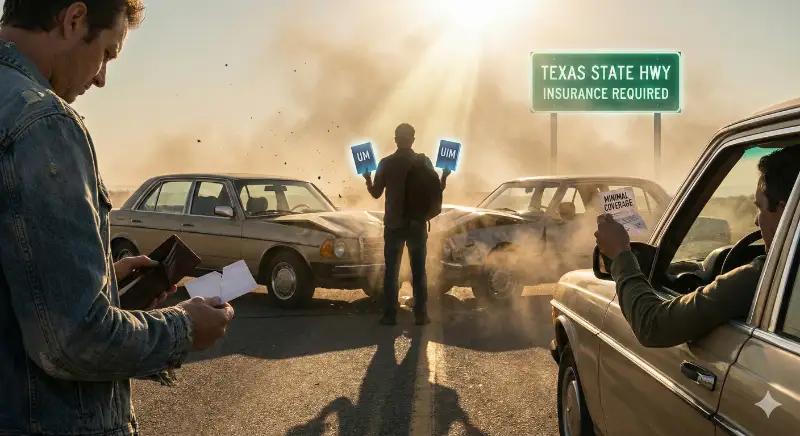
Texas drivers face a sobering reality on the road - roughly 1 in 8 drivers nationwide lacks insurance entirely, according to the Insurance Research Council. The situation hits closer to home when you consider that about 8% of Texas drivers don't carry auto insurance, meaning approximately 1 out of every 12 motorists you encounter has no coverage whatsoever. Harris County presents an even more alarming picture, with about 12% of registered vehicles operating without insurance.
These numbers matter because Texas law mandates minimum liability coverage of $30,000 for injuries per person, $60,000 per accident, and $25,000 for property damage. Yet these minimums crumble under the weight of serious accidents. Consider this: the average overnight hospital stay costs around $11,000, meaning medical bills alone can quickly exhaust the required coverage limits.
This gap between legal requirements and real-world costs creates a dangerous vulnerability for Texas drivers. Uninsured motorist bodily injury coverage and underinsured motorist coverage become critical safeguards when other drivers fail to maintain adequate protection. Understanding how these two types of coverage work - and which situations they address - directly impacts your ability to recover after an accident.
At The Martinez Law Firm, we see firsthand how the wrong coverage decisions can leave accident victims struggling with overwhelming medical bills and lost wages. The difference between uninsured and underinsured motorist protection isn't just a matter of terminology - it determines whether you have the financial resources to rebuild your life after a serious collision.
Texas operates under a financial responsibility system that requires all drivers to demonstrate they can cover damages from accidents they cause. This typically means carrying liability insurance, though the state's approach creates unique challenges for accident victims.
The state mandates what's commonly called 30/60/25 coverage, which establishes these minimum thresholds:
$30,000 for bodily injury per person
$60,000 total for all injuries per accident
$25,000 for property damage per accident
These numbers represent your baseline protection when you cause an accident. However, they create a false sense of security. A single hospital stay can easily exceed the $30,000 individual injury limit, and these figures haven't kept pace with rising medical costs or vehicle values.
Texas holds an unfortunate distinction - ranking dead last among all 50 states for uninsured drivers. Approximately one in ten Texas drivers operates without any insurance coverage, creating substantial risk for everyone sharing the road.
Several factors fuel this crisis:
Skyrocketing Insurance Costs - Rates jumped 23.8% in 2022 and 25.5% in 2023
Financial Hardship - Texas ranks 38th nationally in financial safety
Economic Barriers - Low-income communities face particular challenges accessing coverage
The penalties for driving uninsured include fines between $175-$350 for first offenses and $350-$1,000 for repeat violations. Violators also face license suspension, vehicle impoundment, and higher future insurance rates when they do obtain coverage.
Texas follows an at-fault system, placing financial responsibility squarely on the driver who causes an accident. When you're injured by another driver, you'll typically file a claim with their insurance company - not your own.
This system creates several potential obstacles:
Denial of Liability - The other driver's insurance may dispute fault or refuse payment entirely
Inadequate Coverage - Their minimum policy limits may not cover your full damages
No Coverage at All - They might be completely uninsured or underinsured
Texas also operates under modified comparative negligence rules. If you're found 51% or more at fault for an accident, you cannot recover any damages. This rule makes uninsured and underinsured motorist coverage particularly valuable as protection against these scenarios.
The financial protection you need depends on recognizing the distinct scenarios where each type of coverage applies. With about 14% of Texas drivers lacking insurance entirely, understanding these differences becomes crucial for your financial security.
Uninsured motorist bodily injury (UMBI) coverage becomes your lifeline when struck by a driver with zero insurance. This protection steps in to cover essential expenses that would otherwise come out of your pocket:
Medical bills for you and your passengers
Lost wages during your recovery period
Pain and suffering compensation
The significant advantage of UMBI coverage lies in its accessibility - most policies require no deductible, meaning you can access benefits immediately when facing mounting medical expenses.
Underinsured motorist coverage addresses a different but equally dangerous scenario. This protection activates when the at-fault driver carries insurance but insufficient coverage to handle your total damages.
Picture this situation: your injuries and damages total $100,000, but the other driver only maintains Texas's minimum $30,000 liability coverage. UIM coverage would bridge this $70,000 gap, depending on your policy limits. Without this protection, you'd face the impossible choice between absorbing massive financial losses or pursuing a likely uncollectible judgment against an underinsured driver.
Uninsured motorist property damage (UMPD) coverage protects your vehicle and belongings when uninsured drivers cause accidents. This coverage typically requires only a $250 deductible - substantially lower than most collision coverage deductibles.
UMPD coverage extends beyond basic vehicle repairs to include:
Property replacement inside your car
Rental car expenses during repairs
Every 43 seconds, someone experiences a hit-and-run accident somewhere in the United States. These incidents create unique challenges because the responsible party disappears, leaving victims without recourse through traditional insurance claims.
Fortunately, UM/UIM coverage treats hit-and-run situations as uninsured motorist cases, providing essential protection when you need it most. The key requirement for coverage activation is documented contact between vehicles - a crucial detail that underscores the importance of gathering evidence at accident scenes whenever possible.
The claims process for UM/UIM coverage presents unique challenges that many drivers don't anticipate. Unlike filing against another driver's insurance company, you're working with your own insurer - yet they may still fight your claim aggressively.
Texas law provides four years from your accident date to file a UM/UIM claim. However, this extended deadline can create false security. Most insurance policies demand prompt reporting regardless of the statutory timeframe. Failing to notify your insurer quickly gives them ammunition to deny your claim entirely, as they'll argue the delay compromised their investigation.
The notification process follows these critical steps:
Contact Your Insurance Company Immediately
Report the accident within 24-48 hours when possible
Document the date and time of your notification call
Provide Initial Accident Details
Basic facts about when and where the accident occurred
Information about the other driver (or lack thereof)
Avoid Detailed Statements Initially
Stick to basic facts during first contact
Request time to consult with an attorney before providing recorded statements
UM/UIM claims operate differently from standard liability cases. Your insurance company essentially "stands in the shoes" of the at-fault driver and becomes responsible for paying damages up to your policy limits. If the other driver had no insurance or fled the scene, you immediately proceed to filing with your own carrier.
This arrangement creates an unusual dynamic. You're asking the company that collects your premiums to pay out potentially significant damages - and their financial interests may conflict with providing full compensation.
Many drivers face an unpleasant surprise when their own insurance company fights them just as aggressively as an at-fault driver's insurer would. We've seen insurance companies employ these tactics repeatedly:
Disputing Fault or Injury Severity
Questioning whether the accident actually caused your injuries
Arguing that pre-existing conditions contributed to your damages
Making Unreasonably Low Settlement Offers
Offering amounts that barely cover immediate medical bills
Ignoring long-term care needs or lost earning capacity
Delaying or Ignoring Valid Claims
Requesting excessive documentation
Failing to respond to communications within reasonable timeframes
Wrongfully Denying Coverage
Finding technical policy violations to avoid payment
Misinterpreting policy language to limit coverage
After paying your claim, your insurance company will attempt to recover costs from the at-fault driver through subrogation. If they succeed, you might receive your deductible reimbursement. However, you must avoid taking any actions that could destroy your insurer's subrogation rights.
This means you cannot:
Settle directly with the at-fault driver without your insurer's consent
Release the at-fault driver from liability
Take actions that would prevent your insurer from pursuing recovery
Understanding these restrictions protects both your immediate claim and your insurer's ability to recover damages, which ultimately helps keep insurance costs manageable for all policyholders.
At The Martinez Law Firm, we understand the physical, emotional, and financial toll that an accident can take, and we're here to guide you through the legal process and ensure that you receive what you deserve.
We provide a no-cost, no-obligation consultation where you can discuss your accident details without any pressure or upfront costs. During this meeting, our attorneys will:
Evaluate Your Case's Strengths - We assess the specific circumstances of your accident and identify the best legal strategies
Explain Your Legal Options - You'll receive clear guidance on your rights under Texas law
Outline Potential Strategies - We develop a roadmap tailored to your unique situation
Our attorneys meticulously assess every aspect of your losses to ensure nothing is overlooked:
Medical Expenses - Current treatments and future medical needs
Lost Wages and Earning Capacity - Income lost during recovery and any reduced future earnings
Vehicle Depreciation - Accounting for 10-30% value loss after accidents
Pain and Suffering - Compensation for physical and emotional distress
We work exclusively on a contingency fee basis—typically 33.3% of your settlement amount. This means you pay nothing unless we win your case, aligning our success directly with yours.
Our experienced team assists accident victims throughout Austin and surrounding communities, including Buda, Kyle, Bastrop, San Marcos, Pflugerville, and Round Rock. This extensive coverage ensures you receive prompt, accessible legal support regardless of where your accident occurred.
Our clients consistently praise both our communication and results: "I was treated with the greatest experience ever. My case wasn't very large, but I received the utmost respect". This dedication has helped us recover millions for accident victims while ensuring they pay nothing unless we win.
Understanding the distinctions between uninsured and underinsured motorist coverage becomes clearer when you examine how each type of protection responds to specific accident scenarios. The following comparison highlights the critical differences that determine which coverage applies to your situation:
|
Feature |
Uninsured Motorist Coverage |
Underinsured Motorist Coverage |
|
Purpose |
Covers accidents involving drivers with no insurance |
Covers accidents when at-fault driver's insurance is insufficient |
|
Medical Coverage |
- Medical bills |
Covers expenses exceeding at-fault driver's policy limits |
|
Property Damage |
- Vehicle repairs |
Not specifically mentioned |
|
Deductible |
Typically no deductible for bodily injury; |
Not specifically mentioned |
|
Hit-and-Run Coverage |
Yes (requires vehicle contact) |
Not applicable |
|
Filing Deadline |
4 years from accident date |
4 years from accident date |
|
Coverage Limits |
Matches your policy limits |
Difference between at-fault driver's coverage and total damages |
|
Activation Trigger |
When other driver has no insurance |
When other driver's insurance is below needed coverage |
The most important distinction lies in when each type of coverage activates. Uninsured motorist coverage steps in immediately when the at-fault driver has zero insurance. Underinsured motorist coverage, however, only becomes relevant after the at-fault driver's insufficient policy limits are exhausted.
This difference matters because many Texas drivers assume they're fully protected with just one type of coverage. The reality is that both protections serve distinct purposes and address different gaps in your financial safety net.
The stark reality facing Texas drivers cannot be ignored - with 8% of motorists lacking insurance entirely and many more carrying inadequate coverage, your financial protection depends on the coverage choices you make today. Uninsured and underinsured motorist coverage serves as your safety net when other drivers fail to meet their legal obligations.
Medical costs continue to soar, and a single serious accident can generate expenses far exceeding Texas's minimum liability requirements. When the at-fault driver has no insurance or insufficient coverage, these costs shift directly to you unless you have the proper protection in place. The difference between financial stability and devastating debt often comes down to understanding which coverage protects you in each scenario.
Uninsured motorist coverage steps in when you're hit by drivers with no insurance whatsoever, while underinsured motorist coverage bridges the gap when the at-fault driver's policy limits fall short of your actual damages. Both types of protection work together to ensure someone else's poor coverage decisions don't destroy your financial future.
Filing these claims presents unique challenges that many people don't expect. Your own insurance company may resist paying your claim despite years of premium payments, using the same tactics they would employ against any other claimant. This reality makes experienced legal representation crucial for securing fair compensation.
At The Martinez Law Firm, we understand the physical, emotional, and financial toll that accidents can take when inadequately insured drivers cause harm. We work tirelessly to ensure insurance companies honor their obligations and provide the compensation you deserve for your injuries and losses. Most importantly, you pay nothing unless we successfully resolve your case.
Texas roads present daily risks that no driver can completely avoid. The question isn't whether you might encounter an uninsured or underinsured driver - it's when. Proper coverage combined with skilled legal advocacy provides security that extends far beyond any premium cost.
Review your current policy today and contact us at (512) 444-0025 for a free case evaluation if you need assistance after an accident. We're here to guide you through this complex process and fight for the compensation you deserve.
Understanding the critical differences between uninsured and underinsured motorist coverage in Texas can protect you from financial devastation when accidents occur with inadequately insured drivers.
• Texas has alarming uninsured driver rates: About 8% of Texas drivers lack insurance entirely, meaning 1 in 12 motorists on the road could leave you financially vulnerable after an accident.
• Minimum coverage falls dangerously short: Texas's required $30,000/$60,000/$25,000 liability minimums rarely cover serious accident costs, especially when average hospital stays cost $11,000+ per night.
• UM coverage protects against zero-insurance drivers: Uninsured motorist coverage pays your medical bills, lost wages, and pain/suffering when hit by drivers with no insurance, typically without deductibles.
• UIM coverage bridges dangerous gaps: Underinsured motorist coverage activates when at-fault drivers have insurance but insufficient limits to cover your full damages—critical protection in serious accidents.
• Your own insurer may fight your claim: Surprisingly, insurance companies often deny or lowball UM/UIM claims despite years of premium payments, making legal representation essential for fair compensation.
• Time limits matter but prompt reporting is crucial: While Texas gives you four years to file UM/UIM claims, most policies require immediate accident notification to avoid claim denials.
With rising medical costs and vehicle values, both coverages work together as essential financial protection against Texas's significant population of uninsured and underinsured drivers.
Q1. Is uninsured motorist coverage necessary in Texas? While not legally required, uninsured motorist coverage is highly recommended in Texas. With about 8% of Texas drivers lacking insurance, this coverage can protect you from potentially devastating financial consequences if you're in an accident with an uninsured driver. It helps cover medical bills, lost wages, and other expenses that you'd otherwise have to pay out of pocket.
Q2. What's the difference between uninsured and underinsured motorist coverage? Uninsured motorist coverage protects you when you're in an accident with a driver who has no insurance at all. Underinsured motorist coverage, on the other hand, kicks in when the at-fault driver has insurance, but their policy limits aren't enough to cover all your damages. Both types of coverage are crucial for comprehensive protection on Texas roads.
Q3. How does underinsured motorist coverage work in Texas? Underinsured motorist coverage in Texas bridges the gap between the at-fault driver's insurance limits and your total damages. For example, if your injuries cost $100,000 but the at-fault driver only has $30,000 in coverage, your underinsured motorist policy could potentially cover the remaining $70,000, depending on your policy limits.
Q4. What should I do if I'm in an accident with an uninsured driver in Texas? If you're in an accident with an uninsured driver in Texas, it's crucial to report the incident to your insurance company promptly. If you have uninsured motorist coverage, you'll file a claim with your own insurer. Document the accident scene, gather witness information, and consider consulting with a personal injury attorney to ensure you receive fair compensation.
Q5. How long do I have to file an uninsured/underinsured motorist claim in Texas? In Texas, you generally have four years from the date of the accident to file an uninsured or underinsured motorist claim. However, it's important to notify your insurance company about the accident as soon as possible, as many policies require prompt reporting. Delaying notification could potentially give your insurer grounds to deny your claim.

A staggering statistic reveals the harsh reality facing Texas accident victims: one in five drivers on our roads operates without insurance. Emergency room visits, surgeries, and rehabilitation costs can quickly spiral into tens of thousands of dollars, creating financial devastation for families already dealing with physical injuries and emotional trauma.
The process of securing payment for medical expenses after a Texas car accident creates additional stress during an already overwhelming time. Texas operates under an at-fault insurance system, which means the responsible driver and their insurance company should cover all accident-related damages, including your medical bills. Unfortunately, this payment process rarely occurs swiftly or without complications.
Most Texas drivers carry only the state's minimum liability insurance requirements—$30,000 for injuries to one person and $60,000 for injuries involving multiple people. These coverage limits fall far short of what serious accident injuries actually cost. However, Texas drivers do have several immediate options through their own insurance policies to address these urgent medical expenses.
At The Martinez Law Firm, we understand the physical, emotional, and financial toll that an accident can take, and we're here to guide you through the legal process and ensure that you receive what you deserve. This guide will explain exactly how to secure payment for your medical bills after a Texas car accident, outline your available coverage options, and demonstrate the steps to take when the at-fault driver cannot fully compensate you for your expenses.
The complex landscape of medical bill payment after Texas car accidents requires understanding the state's insurance framework. This system directly determines who bears financial responsibility for your injuries and recovery costs.
Texas operates under an at-fault insurance system, placing financial responsibility squarely on the driver who caused the accident. This means the responsible driver and their insurance provider must pay for all resulting damages, including both property damage and medical expenses. Unlike no-fault states, Texas requires clear proof that another driver was negligent before their insurance will cover your costs.
However, securing these payments presents significant challenges. Insurance companies frequently employ tactics designed to delay, deny, or minimize claims to protect their financial interests. Common strategies include:
• Arguing that you were partially responsible for the accident • Claiming insufficient evidence to prove their driver's negligence
• Questioning the necessity or extent of your medical treatment • Offering quick, low-ball settlements before you understand your full damages
Texas state law mandates that all drivers carry minimum liability insurance: $30,000 per person for injuries ($60,000 per accident total) and $25,000 for property damage. This bodily injury coverage specifically pays for other people's medical bills, lost wages, pain and suffering, and funeral costs when you cause an accident.
Unfortunately, these minimum coverage amounts prove insufficient for serious injuries. Consider these common scenarios:
Emergency room visit and surgery: $50,000-$100,000
Traumatic brain injury treatment: $200,000-$500,000
Spinal cord injury rehabilitation: $500,000-$1,000,000
When accident damages exceed the at-fault driver's coverage limits, you face substantial out-of-pocket expenses unless you have additional protection through your own insurance policy.
Texas employs a "modified comparative fault" system when both drivers share responsibility for an accident. This legal framework operates through three key principles:
Fault Assignment: Each driver receives a percentage of fault based on their actions
Proportional Reduction: Your compensation decreases by your percentage of fault
50% Rule: You cannot recover any damages if you're more than 50% responsible
Here's how this works in practice: If your medical bills total $20,000 but you were determined to be 40% at fault, you can only recover $12,000 (60% of your damages) from the other driver's insurance. This percentage-based reduction applies to all damages, including medical expenses.
This shared liability concept adds significant complexity to insurance claims, making proper evidence collection crucial from the moment the accident occurs. Police reports, photographs, witness statements, and digital data can all help establish an accurate fault determination. The stronger your evidence, the better your position when insurance companies attempt to shift blame.
Waiting for the at-fault driver's insurance company to process your claim can take months, while medical bills demand immediate attention. Several coverage options can provide the financial relief you need to focus on your recovery rather than mounting expenses.
Personal Injury Protection (PIP) serves as your most important immediate resource after a Texas accident. All auto policies in Texas automatically include PIP coverage unless you specifically decline it in writing. This no-fault coverage activates regardless of who caused the accident, providing instant financial relief for medical bills and related expenses.
PIP provides comprehensive protection through four key areas:
Medical Expenses: 100% coverage up to your policy limit
Lost Income: 80% of wages if you were employed at the time of the accident
Substitute Services: Compensation for household duties you cannot perform
Funeral Expenses: Coverage when needed
Most Texas drivers maintain at least $2,500 in PIP coverage, though you can increase this protection to $5,000 or $10,000 for additional security.
Medical Payments coverage (MedPay) functions similarly to PIP but offers distinct advantages. While Texas insurers are not required to offer MedPay, this coverage provides immediate payment for accident-related medical expenses regardless of fault.
MedPay eliminates common insurance barriers—no deductibles or co-payments apply, with coverage beginning from the first dollar of expenses. This coverage typically includes emergency treatment, hospital stays, surgeries, and rehabilitation services directly connected to your accident injuries.
One significant advantage: insurance companies that pay MedPay benefits typically lack subrogation rights, meaning they cannot seek reimbursement from your future settlement.
Your regular health insurance can cover accident-related treatments while you pursue compensation from the responsible driver. However, if you receive a settlement, your health insurer may seek reimbursement for accident-related expenses they covered.
Most health insurance policies require you to pay applicable deductibles and co-payments upfront, making this option less attractive than PIP or MedPay for immediate coverage needs.
If you lack sufficient insurance coverage, many healthcare providers offer treatment through medical liens. Under this arrangement, providers agree to treat you immediately while placing a legal claim (lien) on your future settlement.
Texas hospitals that provide treatment within 72 hours of an accident can file a lien on your personal injury claim. These liens are limited to three specific areas:
Hospital Charges: Only during your first 100 days of hospitalization
Settlement Percentage: Maximum of 50% of your total settlement amount
Court Awards: The amount awarded by the court for hospital services, minus attorneys' fees
Letters of Protection work similarly but with less formality—your attorney provides written assurance that providers will receive payment from your settlement.
Texas law mandates insurance coverage, yet many drivers continue to operate vehicles without adequate protection or carry only minimum coverage limits. These scenarios create significant challenges for accident victims facing substantial medical bills when the responsible party lacks sufficient resources to pay.
UM/UIM coverage serves as your financial safety net when the at-fault driver has no insurance or inadequate coverage limits. This optional protection essentially substitutes for the liable party's missing or insufficient insurance, providing compensation for:
Medical expenses and ongoing treatment costs
Lost wages during recovery
Pain and suffering damages
Long-term disability impacts
Texas insurance companies must offer UM/UIM coverage to all policyholders, though drivers can decline it in writing. Given the significant number of uninsured motorists on Texas roads, maintaining this protection proves essential for your financial security.
When insurance coverage proves inadequate, filing a personal injury lawsuit against the at-fault driver provides an additional legal avenue. Through this court action, you can pursue compensation for:
Past and future medical expenses
Lost income and reduced earning capacity
Pain and suffering
Diminished quality of life
Texas imposes a two-year statute of limitations for personal injury claims, making prompt legal action crucial to preserve your right to compensation.
Accidents involving criminal conduct, such as DUI incidents, may qualify for assistance through the Texas Crime Victims' Compensation Program. This state-funded resource helps victims with medical expenses, lost wages, and other costs when other payment sources are unavailable. Applications must typically be submitted within three years of the incident to remain eligible for benefits.
Experienced legal representation becomes essential when dealing with the complex aftermath of a car accident. Medical bills continue mounting while you recover, making the difference between proper financial recovery and overwhelming debt often depend on having skilled legal advocacy on your side.
A qualified personal injury attorney builds your case through systematic evidence collection that strengthens your claim. This comprehensive approach includes securing police reports, gathering witness statements, and obtaining video footage that might otherwise disappear. Furthermore, attorneys work with accident reconstruction experts to recreate the crash scenario, establishing exactly how the collision occurred. These specialists analyze vehicle dynamics, impact points, and driver behavior to create a compelling picture of fault.
We understand the complexities of workplace injury laws in Texas and are committed to fighting tirelessly on behalf of our clients to ensure proper evidence collection protects your rights.
Insurance adjusters often employ calculated tactics to minimize settlements. Their primary goal involves protecting their company's financial interests, not ensuring your medical bills get paid. Your lawyer levels this playing field through several key strategies:
Handling All Communications with Insurers
Challenging Unfair Fault Determinations
Calculating Your Claim's Full Value
Preparing for Litigation if reasonable settlement offers aren't forthcoming
Healthcare providers and insurers often place liens against your compensation after settlement. An experienced attorney can negotiate these claims down, sometimes substantially. This process requires understanding complex laws governing different types of liens, particularly those from government programs like Medicaid. Through skilled negotiation, your lawyer ensures you keep more of your settlement money.
The Martinez Law Firm has secured over half a billion dollars for clients while serving Austin, Buda, Kyle, Bastrop, San Marcos, Pflugerville, and Round Rock. Our team includes former insurance defense attorneys who understand insurers' tactics firsthand.
During your complimentary consultation, our attorneys will review your accident details and advise you of all legal options. You'll pay nothing unless we win your case. This contingency arrangement ensures you can access quality legal representation without upfront costs during an already financially stressful time.
At The Martinez Law Firm, we understand the physical, emotional, and financial toll that an accident can take, and we're here to guide you through the legal process and ensure that you receive what you deserve.
Medical bill payment after a car accident in Texas requires swift action and strategic decision-making. The complex insurance landscape, combined with mounting healthcare costs, can overwhelm families already facing physical and emotional recovery challenges.
Your protection begins with understanding these critical steps:
Seek immediate medical attention and document all treatment
Activate your PIP or MedPay coverage to address urgent expenses
Contact an experienced attorney within the two-year statute of limitations
Preserve all evidence related to the accident and your injuries
The reality remains stark: with one-fifth of Texas drivers operating without insurance, UM/UIM coverage becomes essential protection. Medical liens and subrogation claims can significantly reduce your final settlement if not handled properly by skilled legal representation.
At The Martinez Law Firm, we understand the complexities of workplace injury laws in Texas and are committed to fighting tirelessly on behalf of our clients. Our team will handle every aspect of your case—from proving fault and challenging insurance company tactics to negotiating medical liens that could otherwise consume your settlement. We proudly serve accident victims throughout Austin, Buda, Kyle, Bastrop, San Marcos, Pflugerville, and Round Rock.
Don't allow medical bills to compound your recovery challenges. Contact The Martinez Law Firm today at (512) 444-0025 for a free case evaluation. We work on a contingency fee basis, meaning you pay nothing unless we secure compensation for your case.
Getting your medical bills paid after a Texas car accident requires understanding multiple coverage options and acting quickly to protect your rights.
• Use immediate coverage first: Personal Injury Protection (PIP) and MedPay provide instant medical bill coverage regardless of fault, while you wait for the at-fault driver's insurance to pay.
• Texas follows at-fault rules: The responsible driver's insurance must pay your medical bills, but with 20% of drivers uninsured, having UM/UIM coverage protects you when they can't pay.
• Act within two years: Texas has a strict two-year statute of limitations for personal injury claims, making prompt legal action essential to preserve your right to compensation.
• Lawyers maximize your recovery: Experienced attorneys prove fault, negotiate with insurers, and reduce medical liens to ensure you keep more of your settlement money.
• Multiple payment options exist: From health insurance and medical liens to the Texas Crime Victims' Compensation Program, several pathways can help cover immediate medical costs while pursuing full compensation.
Remember that insurance companies prioritize their profits over your medical bills. Having knowledgeable legal representation levels the playing field and ensures you receive the full compensation needed to cover your accident-related expenses and recovery.
Q1. How are medical bills typically paid after a car accident in Texas? In Texas, the at-fault driver's liability insurance is responsible for paying your medical bills through a lump-sum settlement at the end of your claim. However, your Personal Injury Protection (PIP) coverage can often be used to cover initial medical costs, regardless of who was at fault in the accident.
Q2. What options do I have if the at-fault driver is uninsured or underinsured? If the at-fault driver is uninsured or underinsured, you can use your Uninsured/Underinsured Motorist (UM/UIM) coverage to pay for your medical bills. Additionally, you may consider filing a personal injury lawsuit against the driver or exploring assistance through the Texas Crime Victims' Compensation Program if criminal behavior was involved.
Q3. Is there a time limit for filing a car accident claim in Texas? Yes, Texas has a two-year statute of limitations for personal injury claims related to car accidents. It's crucial to take legal action within this timeframe to preserve your right to compensation for medical bills and other damages.
Q4. How can a lawyer help me get my medical bills paid after a car accident? A lawyer can assist by proving fault, gathering evidence, negotiating with insurance companies, and reducing medical liens. They can also calculate the full value of your claim and prepare for litigation if necessary, ensuring you receive fair compensation to cover your medical expenses.
Q5. What immediate options are available to cover medical costs while waiting for a settlement? Several immediate options are available to cover medical costs, including using Personal Injury Protection (PIP) or Medical Payments (MedPay) coverage from your auto insurance policy, utilizing your health insurance, or arranging treatment through medical liens where providers agree to be paid from your future settlement.

Car accidents rank among the most frequent causes of Post-Traumatic Stress Disorder (PTSD), creating psychological wounds that prove just as debilitating as physical injuries. Many victims pursuing ptsd car accident compensation remain unaware they hold legitimate claims for their mental suffering.
PTSD symptoms frequently emerge within three months of a traumatic car accident and persist for a year or longer without proper treatment. These symptoms devastate daily life—disrupting relationships, work performance, and overall well-being. You should understand that ptsd from car accident settlement claims are legitimate legal actions, allowing you to receive financial compensation for psychological trauma in the same manner as physical injuries.
We understand the physical, emotional, and financial toll that an accident can take, and we're here to guide you through the legal process while you focus on recovery. PTSD cases require careful documentation and experienced legal representation to ensure you receive the compensation you deserve.
This guide explains everything you need to know about personal injury ptsd compensation—from recognizing symptoms to building a strong legal case for maximum settlement recovery. We'll walk you through the essential steps to protect your rights and secure the financial support necessary for your healing process.
Post-traumatic stress disorder after a car accident extends far beyond feeling shaken up. This condition affects approximately 1 in 4 car crash survivors globally, creating psychological challenges that deserve proper understanding and compensation.
PTSD is a trauma-related disorder characterized by four core symptom clusters: intrusive recollections, avoidance of trauma-related stimuli, negative alterations in cognitions or mood, and heightened arousal lasting longer than one month.
Your brain switches to "survival mode" during a traumatic event like a car crash, prioritizing immediate safety over normal emotional processing. This overwhelming experience can exceed your natural coping mechanisms, fundamentally altering how your brain functions.
These changes aren't temporary inconveniences—they can lead to significant difficulties with memory, concentration, and emotional regulation if left untreated. PTSD symptoms often emerge within one month of the crash and can persist for years without proper intervention.
Car accidents represent the leading cause of PTSD in the general population. The sudden, unexpected, and potentially life-threatening nature of these incidents creates perfect conditions for psychological trauma.
Between 25-33% of people involved in road incidents may develop PTSD within 30 days. This high prevalence stems from several factors: the abrupt loss of control, genuine fear for life, and the violent, shocking nature of crashes.
Research indicates certain groups face higher risks, including women, those with previous psychiatric conditions, individuals who perceived a threat to their lives during the accident, and survivors who were not at fault.
PTSD involves persistent, intense symptoms that significantly interfere with daily functioning, unlike normal post-accident anxiety. Many people experience temporary stress after a crash—feeling nervous about driving or having occasional worries—but PTSD goes beyond these reactions.
The key differences involve symptom severity, duration, and impact. Flashbacks feel vivid and overwhelming, avoidance behaviors become debilitating, and hypervigilance persists regardless of actual danger. PTSD often leads to relationship difficulties, employment problems, and substantial decreases in quality of life.
Understanding these distinctions proves crucial when pursuing ptsd car accident compensation, as documentation of clinical symptoms rather than general distress strengthens your claim and increases your chances of receiving fair compensation.
The psychological aftermath of a car accident extends far beyond initial shock. PTSD symptoms typically emerge within three months of the crash and persist for months or even years, causing profound disruption to daily functioning.
PTSD after a car accident manifests through persistent re-experiencing of the traumatic event. Victims frequently report intense flashbacks that make them feel as if they're reliving the crash moment by moment. These intrusive memories arrive unexpectedly, triggering overwhelming fear and physical reactions like racing heart and sweating.
Sleep Disturbances and Recovery Complications
Sleep disturbances represent another common symptom, with studies showing that nightmares about the accident contribute to chronic sleep deprivation. These disruptions create a cycle of fatigue that further complicates recovery.
Emotional responses often include heightened states of arousal—being easily startled, feeling constantly on edge, and experiencing angry outbursts. Many survivors develop what clinicians call "emotional numbing," an inability to experience positive emotions or connect with loved ones.
Following a car accident, many victims develop avoidance behaviors as protective mechanisms against trauma triggers. Studies show this commonly manifests as vehophobia—intense fear of driving or riding in vehicles.
Survivors may avoid:
Driving altogether or specific driving situations
Routes that pass near the accident location
Conversations about the accident
Places or activities that trigger memories
Research indicates these avoidance behaviors often lead to significant lifestyle limitations. Even cases with minor physical injuries can result in psychological avoidance that severely restricts independence and mobility.
The impact of PTSD extends into every aspect of a survivor's life. Studies reveal that PTSD patients are less likely to regain full-time employment following an accident, with unemployment rates actually increasing from six months to one year post-accident.
Professional and Personal Consequences
Work Performance Issues: PTSD symptoms such as concentration difficulties and hyperarousal directly affect job performance
Relationship Strain: The condition frequently damages personal relationships through emotional numbness, erratic mood swings, and social withdrawal
Dual Mental Health Burden: Research shows that 92% of PTSD patients develop comorbid depression within six months, creating additional challenges that further diminish quality of life
Understanding these symptoms proves essential when pursuing ptsd car accident compensation, as proper documentation strengthens your personal injury ptsd compensation claim.
Seeking timely treatment after experiencing trauma from a car accident can significantly impact both your recovery and the strength of your ptsd car accident compensation claim. Understanding when and where to get help is crucial for healing and building a solid legal foundation for your case.
We recommend seeking immediate professional evaluation if symptoms persist beyond a few weeks after your accident or notably interfere with your daily functioning. Critical warning signs that require prompt attention include:
Intense emotions that don't improve over time
Frightening flashbacks or intrusive thoughts about the accident
Sleep disturbances and recurring nightmares
Increasing social isolation or relationship difficulties
If you experience thoughts of self-harm, don't hesitate to visit an emergency department or call 988 immediately. Your safety and well-being are the top priorities.
Cognitive Behavioral Therapy (CBT) serves as the primary treatment approach for accident-related PTSD. The most effective specialized forms include:
Trauma-Focused CBT – Helps identify triggers and reframe problematic thinking patterns
EMDR Therapy – Uses guided eye movements while processing traumatic memories
Prolonged Exposure Therapy – Involves controlled confrontation of accident-related fears
Cognitive Processing Therapy – Addresses painful emotions like shame and guilt
While no medications are FDA-approved specifically for PTSD, healthcare providers often prescribe:
Selective serotonin reuptake inhibitors (SSRIs) like paroxetine and sertraline
Anti-anxiety medications for specific symptoms
Peer support groups provide valuable complementary support. Although they may not directly reduce PTSD symptoms, they offer emotional relief and connection to others with similar experiences.
Early intervention proves critical since proper treatment initiated promptly can prevent PTSD from becoming chronic. Research shows approximately 25% of trauma-exposed individuals meet PTSD criteria one month post-accident, yet without treatment, 40% continue experiencing significant symptoms even a decade later.
At The Martinez Law Firm, we understand that getting proper documentation of your diagnosis and treatment also strengthens any future personal injury ptsd compensation claim. We work closely with medical professionals to ensure your treatment records accurately reflect the impact of your accident-related trauma.
Understanding your legal options becomes crucial after receiving proper diagnosis and treatment. Pursuing ptsd car accident compensation requires knowing your rights and working with experienced legal representation to secure fair settlement amounts.
Courts recognize PTSD as a legitimate basis for compensation claims, even without physical injuries. Canadian courts treat psychological injuries from auto accidents the same way they handle physical injury claims. This legal recognition provides essential protection for accident victims suffering from trauma-induced mental health conditions.
Personal injury PTSD compensation typically includes several categories of damages that address both immediate and long-term impacts:
Medical Expenses: Therapy sessions, psychiatric evaluations, and medication costs
Lost Income: Wages lost due to inability to work and diminished earning capacity
Pain and Suffering: Compensation for emotional distress and reduced quality of life
Future Care Costs: Ongoing treatment and rehabilitation expenses
Award amounts vary considerably based on symptom severity and life impact. PTSD settlements typically range from $50,000 to $120,000, with severe cases potentially reaching $447,550 for non-pecuniary damages.
Establishing a successful PTSD claim requires demonstrating three key elements:
Clinical Diagnosis: Formal diagnosis from qualified mental health professionals
Causation Link: Clear connection between the accident and your psychological condition
Functional Impact: Evidence showing how PTSD affects your daily life and relationships
Building a strong case requires comprehensive documentation:
Medical Records: Complete diagnosis reports and treatment history
Therapy Notes: Detailed records from counseling sessions and psychiatric visits
Personal Testimonials: Statements from family, friends, and colleagues about changes in your behavior
Expert Witness Statements: Professional opinions linking your condition to the accident
An experienced personal injury attorney provides invaluable assistance throughout the claims process:
Evidence Gathering: Collecting and organizing appropriate medical documentation
Expert Coordination: Working with mental health professionals to strengthen your case
Insurance Negotiations: Handling complex insurance negotiations to secure fair compensation
Case Presentation: Effectively presenting your claim to maximize settlement potential
We understand that dealing with PTSD while pursuing legal action can feel overwhelming. At The Martinez Law Firm, we handle the legal complexities while you focus on recovery, ensuring you receive the compensation necessary for your healing process.
PTSD from car accidents represents a serious condition that deserves proper legal recognition and fair compensation. At The Martinez Law Firm, we understand that psychological injuries can be just as devastating as physical trauma, affecting every aspect of your daily life and future prospects.
Seek Immediate Medical Attention : Early diagnosis and treatment strengthen both your recovery and your legal case
Document Everything : Medical records, therapy notes, and witness statements form the foundation of successful claims
Understand Your Rights : PTSD claims are legitimate legal actions, even without accompanying physical injuries
Don't Accept Quick Settlement Offers : Insurance companies often undervalue psychological trauma cases
The financial impact extends far beyond immediate treatment costs. Lost wages, diminished earning capacity, and ongoing therapy expenses create significant burdens for accident survivors. PTSD settlements typically range from $50,000 to $120,000, with severe cases potentially reaching higher amounts depending on the long-term effects on your life.
Insurance companies understand that PTSD cases require extensive documentation and expert testimony. They may attempt to minimize your psychological suffering or question the connection between your accident and your condition. An experienced personal injury attorney can protect your rights by gathering proper medical evidence, working with mental health experts, and ensuring you receive fair compensation for your trauma.
Time is crucial when pursuing PTSD compensation claims. Statutes of limitations apply to these cases, and early legal intervention helps preserve essential evidence while you focus on your recovery.
Don't let insurance companies minimize your psychological suffering. Your mental health matters, and you deserve compensation that reflects the true impact of your trauma. Contact The Martinez Law Firm today at (512) 444-0025 for a free case evaluation. We proudly serve accident victims throughout Austin, Texas, and surrounding areas, including Buda, Kyle, Bastrop, San Marcos, Pflugerville, and Round Rock. Your recovery is our priority, and we're here to fight for the justice you deserve.
Understanding your rights and options for PTSD compensation after a car accident can make the difference between struggling alone and getting the support you deserve for recovery.
• PTSD affects 1 in 4 car crash survivors and is legally recognized as compensable injury, even without physical damage • Seek professional help within weeks if experiencing flashbacks, nightmares, or avoidance behaviors that interfere with daily life • Document everything: medical records, therapy notes, and impact testimonials strengthen your compensation claim significantly • PTSD settlements typically range from $50,000-$120,000, covering therapy costs, lost wages, and pain and suffering • Early intervention improves recovery outcomes while building stronger legal documentation for your case
The psychological trauma from car accidents deserves the same serious attention and compensation as physical injuries. With proper medical support and legal guidance, you can focus on healing while pursuing the financial recovery that reflects the true impact of your suffering.
Q1. What is the typical compensation range for PTSD after a car accident? PTSD settlements after car accidents generally range from $50,000 to $120,000. However, in severe cases, compensation can reach up to $447,550 for non-pecuniary damages. The exact amount depends on factors such as symptom severity and impact on daily life.
Q2. How soon after a car accident should I seek help for potential PTSD? It's advisable to seek professional help if symptoms persist beyond a few weeks after the accident or significantly interfere with your daily functioning. Early intervention is crucial, as proper treatment initiated promptly can prevent PTSD from becoming chronic.
Q3. Can I claim compensation for PTSD even if I didn't suffer physical injuries in the car accident? Yes, you can claim compensation for PTSD even without physical injuries. Courts recognize PTSD as a legitimate basis for compensation claims, treating psychological injuries from auto accidents the same way they treat physical injury claims.
Q4. What types of evidence are needed to prove PTSD in a legal claim? To prove PTSD in a legal claim, you'll need a clinical diagnosis from qualified professionals, clear evidence connecting the accident to your condition, and documentation showing how PTSD impacts your daily functioning. Medical records, treatment history, therapy notes, and testimonials from family and colleagues are all important pieces of evidence.
Q5. How does PTSD from a car accident affect daily life? PTSD from a car accident can significantly impact daily life, affecting work performance, relationships, and overall well-being. Symptoms may include flashbacks, nightmares, avoidance behaviors, driving phobia, concentration difficulties, and emotional distress. These symptoms can lead to unemployment, social withdrawal, and a decreased quality of life.

Austin drivers face a deadly reality on our city's roads. The most dangerous parts of Austin claimed 60 lives by September 2023 alone. Every time you get behind the wheel, you're 39.2 percent more likely to be involved in an accident compared to drivers elsewhere in the country. The numbers tell a sobering story—2022 brought 122 traffic fatalities to Austin streets, a sharp increase from the 88 deaths recorded in 2019 before the pandemic.
The risks extend far beyond vehicle occupants. More than 56% of all pedestrian crashes occur at intersections throughout our city. Dangerous intersections like 6th Street at Congress Avenue and San Antonio Street at Cesar Chavez Street have become notorious for their accident rates. Some intersections recorded over 68 incidents between 2012 and 2015, leaving 52 people injured. Pedestrians account for approximately one-third of all motor vehicle fatalities in Austin.
At The Martinez Law Firm, we understand the physical, emotional, and financial toll that these accidents can take on victims and their families. We've seen the devastating impact of Austin's most hazardous intersections firsthand through our work with injured clients throughout the city and surrounding communities. This guide will identify the most dangerous locations in Austin for 2025, examine why these areas pose such significant risks, and explain the steps you can take to protect yourself and your loved ones on our roads.
Several intersections throughout Austin have emerged as particularly hazardous locations where serious accidents occur with alarming frequency. Our experience at The Martinez Law Firm has revealed disturbing patterns of collisions at these key locations.
I-35 and Riverside Drive
This intersection remains one of the deadliest in Austin, where high-speed highway traffic collides with local drivers attempting to manage complex entrance and exit ramps. The combination of speed differentials and confusing traffic patterns creates a dangerous environment for all motorists.
Lamar Boulevard and Parmer Lane
Heavy traffic volumes combined with poor visibility make this intersection a recipe for serious accidents. Drivers often struggle to see oncoming traffic, particularly during peak hours when congestion compounds the visibility issues.
North Lamar at Rundberg Lane
This location becomes especially treacherous during rush hours when impatient drivers make dangerous lane changes. The intersection's design encourages aggressive driving behaviors that frequently result in serious collisions.
William Cannon Drive at Menchaca Road
This intersection continues to see an alarming number of T-bone collisions from drivers running red lights. The high-speed approach to this intersection often leaves drivers insufficient time to stop safely.
Guadalupe Street near University of Texas Campus
Pedestrians face extreme danger at this location, where heavy student foot traffic intersects with distracted drivers unfamiliar with the area. The combination of young pedestrians and distracted motorists creates a particularly volatile situation.
We've represented numerous clients injured at these specific locations. Our team understands the unique hazards each intersection presents, which allows us to build stronger cases for victims seeking compensation. If you've been injured at any of these dangerous locations, call us at (512) 444-0025 for a free case evaluation.
Multiple critical factors contribute to the deadly nature of Austin's most hazardous intersections. Understanding these causes helps explain why certain locations consistently see severe accidents and fatalities.
Austin's city planning historically prioritized vehicle speed over pedestrian safety, creating wide lanes and long blocks with insufficient crossing opportunities. This design philosophy from decades past continues to endanger lives today.
The statistics reveal disturbing patterns at signalized intersections:
30% of all crashes and 37% of serious or fatal crashes occur at signalized intersections
Left-turning vehicles colliding with oncoming traffic caused 171 serious injuries or fatalities between 2019 and 2023, accounting for over 12% of all severe non-freeway crashes
Many hazardous intersections cluster around I-35, where drivers transitioning from highway speeds often enter an "autopilot mode" or become distracted. This behavioral shift proves lethal—64% of pedestrian fatalities occur on roads with speed limits of 45mph or higher.
When and where accidents occur reveals additional danger patterns:
80% of pedestrian fatalities happen during nighttime or early morning/late evening hours
While 56% of pedestrian crashes occur at intersections, mid-block locations account for 75% of pedestrian fatalities
At The Martinez Law Firm, we've seen how these design flaws and driver behaviors create perfect storms for catastrophic accidents. Our experience handling cases from these dangerous locations gives us unique insight into establishing liability and securing compensation for victims throughout Austin and surrounding communities.
Austin has responded to this growing safety crisis with several key initiatives designed to address the most dangerous parts of our city. The Vision Zero program leads these efforts, targeting the complete elimination of traffic deaths and serious injuries through systematic safety improvements.
The city has secured significant funding to support these critical improvements:
Federal Grant Funding: Austin received USD 33.70 million from the federal Safe Streets and Roads for All grant program
Targeted Infrastructure Projects: These funds support five protected intersections and one roundabout specifically designed to address historical crash patterns
Advanced Traffic Management System: The city now monitors over 1,100 signalized intersections throughout Austin
Austin has pioneered innovative approaches to intersection safety. The city's traffic management system uses GPS technology rather than traditional road-based sensors to control signal lights. This advancement allows for more responsive and efficient traffic flow management.
Some of the most effective safety measures have required minimal investment. Austin has installed more than 640 leading pedestrian interval crossings since June, giving pedestrians a head start at intersections before vehicles receive the green light. Research demonstrates these treatments reduce pedestrian-vehicle crashes by 13%.
We closely monitor these safety improvements as they can significantly impact liability in personal injury cases. When cities make infrastructure changes, it often affects how courts determine fault in accident claims. If you've been injured at one of Austin's dangerous intersections, contact The Martinez Law Firm at (512) 444-0025 for a free case evaluation. Our understanding of these safety measures helps us build stronger cases for our clients.
Austin's dangerous intersections demand constant vigilance from every driver and pedestrian who travels our city's roads. The evidence is clear—from I-35 and Riverside Drive to Lamar Boulevard and Parmer Lane, these high-risk locations continue to claim lives and cause serious injuries due to poor city planning, inadequate pedestrian infrastructure, and dangerous driver behaviors.
While Austin's Vision Zero program and advanced traffic management systems offer hope for safer roads ahead, the reality remains sobering. Until these critical safety improvements take full effect, extreme caution is essential when traveling through these hazardous areas.
The devastating impact of these dangerous intersections affects real families every day. At The Martinez Law Firm, we witness this impact firsthand through our work with accident victims throughout Austin, Buda, Kyle, Bastrop, San Marcos, Pflugerville, and Round Rock. We understand exactly how these specific locations create liability issues in personal injury cases and how to hold responsible parties accountable.
Don't face the aftermath of a serious intersection accident alone. Our experienced personal injury attorneys will fight for your rights and pursue the compensation you deserve while you focus on recovery. Contact us today at (512) 444-0025 for a free case evaluation. Your safety matters on the road—and your rights matter in the legal process that follows an accident.
Austin drivers face alarming safety risks with specific intersections posing critical dangers that require immediate awareness and caution.
• Austin drivers are 39% more likely to crash than the national average, with 122 traffic fatalities recorded in 2022 alone • I-35 intersections with Riverside Drive and Parmer Lane are among the deadliest due to high-speed highway merging chaos • Over 56% of pedestrian crashes occur at intersections, with 64% of fatalities happening on roads with 45+ mph speed limits • Left-turning vehicles cause 12% of all severe crashes, making protected turns and extra caution essential at major intersections • Austin's Vision Zero program and $33.7 million in federal safety grants are funding intersection redesigns and smart signal systems
The most dangerous intersections cluster around I-35 where highway speeds meet local traffic, creating perfect storms for catastrophic accidents. While the city implements safety improvements through advanced traffic management and pedestrian interval crossings, drivers must remain vigilant at these high-risk locations until comprehensive redesigns are complete.
Q1. What are the most dangerous intersections in Austin for 2025? Some of the most hazardous intersections include I-35 and Riverside Drive, Lamar Boulevard and Parmer Lane, North Lamar at Rundberg Lane, William Cannon Drive at Menchaca Road, and Guadalupe Street near the University of Texas campus. These locations combine factors like high traffic volume, poor visibility, and complex traffic patterns.
Q2. Why are Austin's intersections so dangerous? Austin's intersections are dangerous due to several factors, including historical city planning that prioritized vehicle speed, insufficient pedestrian infrastructure, high-speed transitions from highways, and driver behaviors like distraction and aggressive driving. Additionally, timing plays a role, with most pedestrian fatalities occurring during nighttime or early morning/late evening hours.
Q3. How does Austin compare to the national average for traffic accidents? Austin drivers face a significantly higher risk of accidents compared to the national average. They are 39.2 percent more likely to be involved in an accident than drivers in other parts of the country, highlighting the city's ongoing road safety challenges.
Q4. What is Austin doing to improve road safety? Austin is implementing several initiatives to enhance road safety, including the Vision Zero program aimed at eliminating traffic deaths and serious injuries. The city has secured federal funding for safety projects, is implementing an Advanced Traffic Management System, and has installed leading pedestrian interval crossings at numerous intersections to reduce pedestrian-vehicle crashes.
Q5. When are the most dangerous times to drive in Austin? The most dangerous times to drive in Austin are typically during rush hours (7-9 AM and 4-6 PM) when traffic congestion is at its peak. Additionally, nighttime and early morning/late evening hours pose increased risks, especially for pedestrians. Major events like South by Southwest (SXSW) can also contribute to heightened traffic dangers due to increased congestion and unfamiliar drivers in the area.




Schedule a free consultation with one of our experienced lawyers today by filling out the form below, or call us at 512-444-0025